Showing posts with label China Miéville. Show all posts

Tuesday, January 10, 2012

Best Reads of 2011

Largely, I think, due to reading so many magazines and so many parts of various books for classes, I read the fewest books in 2011 that I did in any year since I started keeping track in 2009. Still, I've ended up with the at least somewhat respectable total of one hundred and nine volumes conquered, and, needless to say, quite a few of those were rather excellent. And so the time has come for the eight best of them, presented in alphabetical order. We begin with…


Reviewed here.

The Wounded and the Slain isn't an exciting book. It's downbeat, instead, not to mention depressing, dejected and dispirited, filled with character and heart and written with a kind of rough poetry. Though there is a crime at the book's center, it's very much a crime with a small c, not a jumping off point to adventure but a tortured, haphazard, regrettable, and, above all, pointless thing. The descent into darkness thing is an inexorable crawl, not a glamorous leap. I don't think you could ever call this a pleasant book, but it's one that'll hit you hard, and it's a damn good one.


Reviewed here.

As stark as it is focused, as streamlined as it is jagged, Red Harvest embodies much of what interests me about the noir genre. Though wholly concerned with matters of justice, this is a compassionless novel, maybe even a(n intentionally) heartless one. Morality here is a brutal force, and the idea of right is relegated to strength and violence. But, in this nigh lawless place, even the lawman, the only one standing up for us, might be corrupt to the core. This is a fast novel, a fun novel, and a damn disturbing one.


Reviewed here.

Like Red Harvest, The Ammonite Violin is disturbing and raw, but here those qualities don't come from bare language, harsh violence, and a lack of emotion but rather from a series of stories that are almost unutterably rich in their composition, filled with overwhelming and enveloping language and positively overflowing with feeling. The longing shown here is the kind of calculated, unbearable, and revelatory longing that might come gushing forth from an excised heart with all the force of the heavy, dark blood that comes with it.


Grimscribe is horror extraordinaire Thomas Ligotti's second collection, and it takes place wholly within nightmare, on the edge of utter dementia itself. Its stories toy with that border, giving glimpses and tantalizing, horrifying hints, leaping across for brief moments where sanity howls before falling back. Amidst it all are several of Ligotti's best tales, including Nethescurial, an insidious and Lovecraftian beast of a tale that can actually be read for free (albeit with an annoying formatting issue or two) here. In my personal rankings, Grimscribe is roughly tied with the author's Songs of aDead Dreamer and Teatro Grottesco for the overall prize of his best work. Suffice to say, this is a brilliant collection.


Reviewed here.

I knew I'd like Sandkings going in, maybe even knew I'd love it, but I didn't know how much. The Stone City is a Science Fiction Weird Tale in every sense of the word, and an absolutely brilliant one at that, fiction that probes the limits of human understanding and strangeness with as much skill as Lovecraft himself brought to the table. This isn't, though, a collection with one centerpiece. Every tale here is filled with breathtaking images and audacity, entire worlds and some of the best characterization you'll ever come across. I know a lot of readers view Martin's older works as a now-done sideshow compared to A Song of Ice and Fire, but doing so is a dire mistake.


Reviewed here.

Embassytown is the rare Science Fiction novel that is not only alien in its choice of colors and its number of tentacles. The aliens shown here are convincingly inhuman, but it's the aspects of language that Miéville uses them to explore that are stranger and more intriguing still. Those concepts are explored in full, taking the humans in the narrative to and past the breaking point, twisting and shattering and reinventing every aspect of their world. Miéville's as skilled as any with coming up with brilliant and challenging ideas, has the ability to ride them for all they're worth, and the talent to present the whole with his fantastic prose. Though it's very different from his early work, Embassytown is no less excellent.


The Dream of Perpetual Motion builds a vivid, colorful, and fascinating world and populates it with larger than life, well explored, and somehow believable characters. I think it says a lot about the novel that I chiefly remember two scenes, one the thrilling, grand, and inventive climax and the other an unimportant scene where the main character eats some rather unpleasant food in a diner. Try as I might, I can't decide which of those I liked best, or which felt more real, and, amazingly enough, the two fit so well into the same narrative that, looking back, they really don't seem all that different in importance at all.


Review to come.

A Fire Upon the Deep operates on a scale so much vaster than what can be easily conceived that the reader's practically pummeled with awe as they turn the pages, and turn them they will. The central plot of A Fire Upon the Deep is a gripping adventure story that takes place amidst an unimaginably complex and fascinating universe, a story filled with grand ideas and with a cast made up in large part of some of the best made and most convincing aliens I've ever seen. A Fire Upon the Deep isn't only one of my favorite books of this year: it's one of my favorite Science Fiction novels ever and even one of my favorite novels.

(THE DUBIOUS HONOR OF) WORST NOVEL


Review here.

Though it also had its fair share of excellence, 2011 packed in more than a few disappointing novels: Boneshaker, If You Could See Me Now, and even the legendary Frankenstein among them. But the latter two had some good ideas, if a fumbled execution, and even Boneshaker was more formless mush than actively bad. Only Wicked Things managed to truly and genuinely piss me off, not because it hadn't met my expectations (though, needless to say, it hadn't) but because it was simply an awful book, one that rambled about aimlessly, setting up numerous hints and clues, and then oh-so-cleverly keeled over dead before resolving anything. Ha ha. Wicked Things tries to be a stylish, plot-based read, but the ending reveal leaves it a thriller that forgot to thrill, a horror novel whose only real horror moment is a and unsubstantiated cheap shot, a novel whose characters are stick figures then jerked out of their unremarkable paths, and a book with nigh no redeeming features.

Tuesday, January 3, 2012

Best Releases of 2011

Yesterday, Strange Horizons put up their Year in Review postwith my own paragraph-long thoughts among those offered. Head on over and take a look. Once you're done, though, keep reading, because the discussion's not yet over. See, at the time of writing the Strange Horizons piece, my computer was down and seemingly dead (thankfully, it recovered soon after). As a result, I didn't have access to my list of books read and so, rather unsurprisingly, forgot the dates of a few notable releases, most importantly Daniel Kraus' Rotters, a YA horror novel about grave robbing that one me over in short order due to the fantastic descriptions of that so-sordid crime and the depiction of the novel's main character. And then there are all the series books, few of which I mentioned. Both White Luck Warrior and The Crippled  God were quite good. The latter maybe even excellent, even if it wasn't my personal favorite Malazan volume. Both, though, lost their places on the list because they were too tied up with the preceding (and, in the case of the former, to come) novels for me to really judge them on their own merits. Finally, there's certainly the matter of Historical Lovecraft, the anthology that came out midway through the year bearing my very first published story.

My post with overall best reads for the year will come out next week. 

For those interested, the full list of newly released books I read is as follows:

  1. Joe Abercrombie – The Heroes
  2. Daniel Abraham – The Dragon's Path
  3. R. Scott Bakker – The White Luck Warrior
  4. James S. A. Corey – Leviathan Wakes
  5. Steven Erikson – The Crippled God
  6. Daniel Kraus – Rotters
  7. Mark Lawrence – Prince of Thorns
  8. George R.R. Martin – A Dance with Dragons
  9. Robert McCammon – The Hunter from the Woods
  10. Haruki Murakami – 1Q84
  11. Adam Nevill – The Ritual
  12. K.J. Parker – The Hammer
  13. Patrick Rothfuss – The Wise Man's Fear
  14. Brandon Sanderson – The Alloy of Law
  15. Sam Sykes – Black Halo
  16. Catherynne M. Valente – Deathless
  17. Historical Lovecraft

Tuesday, September 13, 2011

China Miéville - Embassytown

Embassytown (2011) is a novel about language and Language. In the midst of an alien city, surrounded by alien air, the citizens of Embassytown must communicate with the bizarre Areikei. The surface and biological strangeness of the Areikei, however, is nothing compared to their strangeness of thought. The Areikei, see, do not have symbolic language. To them, what they say is, and what is not cannot be said. In order to even gain such rhetorical tools as similes, the comparisons must be acted out so that they might be used. This is how our narrator, Avice, is introduced to them: she is quite literally made into a simile, transformed into a human girl who in pain ate what was given her in an old room built for eating in which eating had not happened for a time. (p. 26) Into this purity of language and Language and thought comes humanity, and we bring with us the concept of lying – and, with it, the collapse of the Areikei world.

The core of Embassytown's success is that the Language of the Areikei is not a glittering substitute for morality or some other more familiar concept. Language here defines thought and is not only the foundational difference that lends the Areikei their tremendous otherness but also the core of every aspect of Miéville's world building. Furthermore, such themes appears again and again in the novel, reinforced through different moments of epiphany, where consciousness is shifted not through gradual learning but through changes in thought and societal norms. Such layers even enter into the reality and construction of the overall universe. Here, the "real" is a manifestation of the immer, which spaceships slip into in order to travel across vast distances. The way the two relate is, of course, in the manner of thought and speech: "The best we can do is say that the immer underlies or overlies, infuses, is a foundation, is langue of which our actuality is a parole, and so on." (p. 31)

In addition to language, the novel focuses on manners of ruling and, especially, on colonialism. The change in Areikei thought, after all, was brought on from afar. The people of Embassytown, too, are ruled from outside, a situation that could perhaps be compared to American colonists wreaking havoc among the native populations while also squabbling with their far off backers. Much of the novel's politics play through off stage, as befits a book with an outsider main character, but the intrigue manages nonetheless to be believable and interesting once revealed. Through all this, Miéville marks the colony's change with deft shifts in language. At first, Embassytown is an aristocracy, but later it evolves into a nercocracy of language (p. 247) and, later still, even an explorocracy (p. 345). Those in power are, of course, revealed to be far less benevolent than they appear, and the cracks hinted at in the narrator's childhood are thrown wide before the story's close. After one such blackening of the colony's leadership, Avice is forced to reevaluate all those she's known for her whole life: I stared at MagDa. I liked them, I admired them. They'd known about this. (p. 216)

Miéville's approach to responsibility is not as black and white as that quote may imply, however. As lying destroys the Areikei civilization, and the very minds of its inhabitants, a group dedicates themselves to the preservation of the next generation by keeping them safe from ever hearing such a pervasive thing. Their means, of course, are the death of all the humans on the planet. Though it's hard to sully their aims or dedication, the people of Embassytown cannot accept the Areikei coming to kill us for sins we'd committed, if at all, without intent. (p. 278) The final part of that is the most important one. In the final portion of the novel, the end often does come to justify the means, at least when the problem presented is one so colossal. Many of the actions of Avice and her companions could be seen as questionable, including their willingness to let earlier injustices continue while they focus on larger and more immediate problems. When it comes to the ultimate issues of responsibility and to where the blame for the catastrophe's of the tale fall, Miéville's content to let the reader draw their own conclusions. The central questions of the novel – the morality of language, lies, and authority – are presented from different sides (language is the continuation of coercion by other means squaring off against [language is] cooperation), and the only hint Miéville gives about the validity of either side is that they weren't as contradictory as they sounded. (p. 316)

Embassytown is often a punishingly hard read, especially in its opening. The scenes and information shown there are all vital later, but their order often feels almost intentionally difficult to parse. As Avice says of her memory, she recalls episodes very well, but episodes, not a timeline. The most relevant times, the definitional ones. The rest of it's disorganized in my head, and mostly I don't mind. (p. 23) As such, the novel is, until catastrophe lends it order, a menagerie of events arrayed by impact and the vaguest of chronologies. True to its first person narration, Avice rarely explains that which a resident of the town would not need to know. Concepts are taken for granted and definitions often given in initially meaningless in world jargon. This method, though confusing at first, leads to massive payoffs before long. Complex concepts like Ambassadors are not revealed through lifeless exposition but rather through actions and the reader's increasing immersion into Embassytown's society. When the rules we've observed are later violated, our immediate reaction is not to spot an inconsistency in parameters we've been handed but rather the kind of shock that comes from having trusted rules that feel lived through break down. Though challenging, the novel's packed with revelations and rich with implications.

After the work-heavy beginning sections, Miéville refrains from introducing many more elements but rather concentrates on those already established. As such, though the novel's pace is always slow, the second and third acts are far easier reads. There's never a surfeit of external action, but Miéville's ideas are fascinating enough to draw the reader in. Like the author's previous works, Embassytown is loaded with so many good throw away ideas that its leftovers could populate another dozen inventive Science Fiction extravaganzas. Nothing about the world depicted here is static. The most innocuous of details are given consequences and imaginative, dizzyingly strange results, such as the fact that the human city exists in the planet's only area of (manufactured) believable air: Outside, gulls sounded. They veered, headed constantly for the sea they glimpsed kilometers away, were turned back constantly by sculpted winds and aeoli breath. It was very rare that any broke out into the proper local air, and died. (pp. 119-20)

Strangely enough for a novel told entirely in the first person, and one with such a distinctive and admirable voice, our narrator, Avice, is one of the least interesting and important aspects of the book. In fact, characters as a whole takes a back seat here. This is very much a book of ideas, and the people in it are well defined but always peripheral. At no time does our interest come out of a love of anyone presented, and many of Embassytown's officials and the novel's side characters are defined far more by their roles than their personalities. All that being said, Miéville's characterizations are powerful, if often quiet in their construction. Our cast is made up of those who are sympathetic but not without their flaws and petty arrogances, people able to at once devote their lives to their ideals and also change themselves not out of grand declarations and missions but simply because they're "bored." (p. 38)

That surplus of fallible reality defines the romances of the novel as well. Seemingly star crossed lovers soon discover they've little physical chemistry and fairly quickly gave up on sex. (p. 38) Other relationships get even less of a yearning description. Potential attraction between Avice and another character are merely implied by a never unsubstantiated reference of "some prurience." (p. 204) Despite all of that, however, there is a faint romanticism to Avice's narration – perhaps even to Miéville himself, back on the other side of the page – as is always evident in her later dealings with CalVin and her ruminations about a fraternity of those who once loved [her], or still did? (p. 242) Such a thing is like as not more a product of Avice's occasionally quite arrogant mind than of the other characters', but the existence of such ruminations in and of itself is significant.

Miéville's prose is, as expected, filled with the immense vocabulary that it's somewhat infamous for, but his reputation as a stylist does not rest solely on his obscure diction. The writing here differs sharply from that in Perdido Street Station (2000) or The Scar (2002), glimpses supplied for atmosphere as opposed to a baroque concentration of detail, but is no less effective and often stunning in its flow and power: I could say it was depressing, that party, like a walk through purgatory, we at the end of the world rutting into oblivion and drugging ourselves idiot to autogenerated rhythms and a hammer of lights through smoke. Perhaps to those participating it was joyful. (p. 189) Outside of such fantastic paragraphs, the novel is littered with clever combinations and concepts, such as the aforementioned narcocracy (p. 247) and the description, as Embassytown falls apart, of the ruling class as suicide pioneers (p. 218).

Such flourishes never, it must be noted, reach the point of arrogance, and Miéville's able to write hiddledy-piggledy (p. 255) and have it fit the tone as much as he's able to do the same by titling the first section a Proem. Such mixes of erudition and knowing, genre-savvy winks are common here. Examples include references to vampires (p. 320) in the midst of one of the novel's most important chapters and comparisons to zombie movies (Protagonists were in an edifice full of products, and sicker enemies than before relentlessly came for them. (p. 220)). As the conclusion begins, Miéville combines revolutionary fervor and his jokester tendencies, coming up with what's perhaps the most amusing line in the whole affair: "I don't want to be a simile anymore," our narrator says. "I want to be a metaphor." (p. 296)

China Miéville's early work won its fame in part because of its combination of gripping, pulp fun and highly literate intelligence. That grouping seemed abandoned with the man's last two novels, The City and the City (which felt like all the latter) and Kraken (seemingly all the former). Embassytown does not return to that earlier blend. Though certainly strange and often mind bending, this is a book far removed from the monsters and chases that characterized much of, say, Perdido Street Station. But, though it's in a different style, Miéville here shows a level of mastery equal to or, perhaps even greater than, those seminal, movement-defining novels. This is a novel about language and Language, written with a love of language (and Language?) that is the perfect example of Science Fiction as the genre of ideas, a novel powerful enough that, for the time the reader's turning the pages and beyond, the world looks like a genuinely different place. Highly recommended.

Thursday, July 15, 2010

China Miéville Interviewed (Elsewhere)

While I know that I've already done an "Interviewed (Elsewhere)" for Miéville, I found the new interview too interesting to not bring up. Throughout it, we learn quite a bit about Kraken, and, while the whole thing is a must read if you enjoyed or are curious about that novel, the first question was probably the most interesting part for me:

The A.V. Club: The City & The City came across as a careful, tightly controlled book. Kraken, on the other hand, feels much more like an eruption.

China Miéville: [Laughs.] I was wondering how you might gloss that over. Kraken is a very undisciplined book. That’s a gamble. If it doesn’t come off, it’s disastrous. But there are pleasures, I think, to a meandering lack of discipline that you can’t get the other way, and vice versa. You gain something and you lose something. My second book, Perdido Street Station, was the one that a lot of people really, really liked, and it was tremendously sort of rumbustious and ill-disciplined. I feel like I’ve been getting increasingly disciplined since then, and some readers seem to miss that kind of amiable chaos. What I wanted to do with Kraken is tap into what you’ve kindly called an eruption. I wanted to indulge that. It does have a very different feel than The City & The City. It obviously won’t work for everyone, but I always think about books like—and I don’t mean this hubristically—Gravity’s Rainbow. If Gravity’s Rainbow is anything, it’s kind of this dreamlike meander. The idea of saying to Pynchon, “You know, you need to tighten this up,” it would destroy it. Kraken was an effort to tap into that same kind of pleasurable ramble. In some ways, Kraken is more like Perdido, whereas The City & The City was a departure. It’s the kind of thing I’d like to do a lot more of. In some ways, this was getting back to what I was better known for.


That description vocalized a lot of what I feel about Kraken. Like with every novel the man's written, the book impressed me, in this case by not having a few interesting elements and building a story around them, but rather flooding the reader with a never-ending deluge of the weird and bizarre that threatened to drown (me, at the least) under its weight. I also found the comparison with Gravity's Rainbow very interesting, not just because I happen to be wrapping up that very text, but because both are novels of excess that are still, somehow, controlled, and both have to be viewed, at least to some degree, by scaling back the chaos in your mind and sorting out the elements one by one.

Sunday, May 30, 2010

Reading in May


This collection felt like being handed a treasure map. Suddenly, I know just where I’m going when exploring this bizarre sub genre. Yes, not all of the stories worked entirely – Kathe Koja’s, for instance, was too bizarre and irrational for me to get any emotional connection with at all – but the ones that did drastically outweighed the others, and even the not-so-great stories are never trite or boring. If you’re interested in The New Weird, and somehow have not read this yet, it’s absolutely essential.


This was a very interesting biography-esque book, primarily consisting of letters to and from Bulgakov. My only complaint is that the summaries at the beginning of each chapter (detailing the overall events of his life, so as to give the letters some context) could probably have benefited from being spread throughout, rather than lumped at the beginning, as it felt odd in some of the lengthier chapters to go from reading about Bulgakov’s death say, to reading a letter he wrote four years earlier about his dinner plans. Still, if you’re interested in Bulgakov, this’ll shed quite a bit of personal and professional light on the man.


Almost every story in this collection is about finding subtle holes in our understandings of the world, in deconstructing almost every kind of happiness that people find for themselves. That’s not to paint this as a wholly grim work, though, because the beauties of the work come from those same interactions and observations. If I was to compare the writing to any one author, I’d probably go with Stephen King, as odd as that sounds. The stories here, like in King’s work, are not based on forward motion, but rather a flashback and musing filled contemplation of a man’s life, or at least a part of it. This is a quiet work, but an interesting one too.


Though no one part of The Neutronium Alchemist is as jaw dropping as the what’sgoingon!? segment of the Reality Dysfunction, the book as a whole is much stronger, with most of the issues I had with the first book ironed out. Well, except its own infuriating cliffhanger ending. Still, these books are the epitome of wide screen space opera, as far as I can tell, and I can’t wait to dive into The Naked God. Review coming when I’ve finished the series.


20th Century Ghosts is at once exactly what a horror collection should be (disturbing, supernatural, even morbid on occasion), perfectly aware of every one of your expectations (Bobby Conroy Comes Back from the Dead works precisely because it’s nothing like what you expect), and something completely different (such as the touching Pop Art, which is undoubtedly one of the greatest short stories I’ve ever read). If you’re interested in horror, you need to read this as soon as possible. I’ll definitely be returning to these stories on here, though I’ll need some time to gather my thoughts, I expect.

[Note: At the time of writing I still have not read My Father’s Mask, so, technically, I haven’t finished the book. All the same, I’m going to finish the collection by tomorrow (so still May) without a doubt, and I’m unsure about the status of my internet then, so I figured it was better to go through with a blank than to procrastinate and miss the end of the month.]


The Girl Who Loved Tom Gordon seems, at first, like it’ll be an excellent novel. The young girl’s voice is perfect, and the minutia of her struggle to survive, lost, in the woods is gripping. Then the supernatural comes in and – who’s surprised? – it all goes to hell. Not the hell of fire and brimstone, but rather one of wholly absent tension and dues ex machine. Yay. Full review coming at some point.


Apartment 16’s a character driven horror story, and as such it’s a good thing that the characterization’s generally excellent, and the walls positively drip with atmosphere. There are a few problems herein – the ending was a bit of a letdown, Apryl’s character isn’t as captivating as Seth’s, and god do I hate that Y in Apryl – but none of them really matter when stacked up against the work as a whole. Review coming soon.


The first quarter or so of this book was fairly difficult, to be honest. It’s fairly standard in fantasy to have a period of disorientation – nothing makes the world seem quite so exotic and strange as being clueless about it, after all – but here that period goes on for well over a hundred pages, and it starts to get quite annoying. Still, the book does eventually come together. The writing is, as you would expect from Mieville, excellent, and the narrative’s incredibly fun. This isn’t my favorite of his works, but it’s certainly not a disappointment.


This book of essays turned out to not be my thing. At all. Individual portions of essays were appealing – the book had two quote-worthy passages, which was quite impressive for a volume of only 139 pages – but every single one of the essays felt meandering and disjointed, an effect that was only exacerbated if the reader reads more than one in a sitting. Before long, all the boundaries between them break down, whatever hard-to-detect main ideas there might have been long lost, and you’re just drifting along on an endless small-wonders ramble.


Swainston’s novel was one that I was quite looking forward to, and it didn’t disappoint. The Year of Our War is a bizarre, character driven story that looks into immortality and how societies – and people – progress over time. My full review is here.

Thursday, May 13, 2010

China Miéville Interviewed (Elsewhere)

Alright, alright, I'm aware that I'm not the only person to post this interview. In fact, I'll wager that I'm not in the first hundred. I do, however, want to draw attention to a slightly different part of it (though I won't deny that Miéville doing SF is a mouth watering proposition):

It seems sometimes that monsters are only considered valid if they are supported by some deeper meaning, but they can be enjoyed for what they are too,” he said. “When I was a kid I drew squids and robots because I loved them and I still feel that way now.

“Fantasy and science fiction can be literal as well as allegorical and there’s nothing wrong with enjoying a monster like a giant squid for what it is, as well as searching for metaphor.


I think that dichotomy (between social commentary and holy fuck that moth just owned that guy) is precisely what makes Miéville books such excellent reads, and I think it's the skewing of that dichotomy that made The City and The City less gripping than its predecessors.

Wednesday, May 5, 2010

An Addendum to my The City and The City Review

Over on his blog, Graeme posted the reading group questions from the back of The City and The City. Seeing as I'd done a review the day before, I felt that I had no choice at all but to spew out yet more wordage on the subject. My response can be found in the comments to his post, but I'll repost the main part of it here:

China Mieville says that he considers ‘The City & The City’ “a crime novel above all.” Do you agree with his assessment? Why or why not?

Not at all, really. I think that the crime is important in that it's a breach of the social boundaries/rules that govern the novel, but I don't think that it is the defining event by any stretch of the imagination.

Try to think of the novel primarily in science fictional or fantasy terms instead of as a crime novel. Is there any evidence that the novel falls into either of these categories? How would looking at the novel from these perspectives change your perception of the story?

Well...that's exactly how I looked at it, so not much. I simply don't see how The City and The City could be expected to function without at least the guise of its speculative elements. As a crime novel, it's about someone who breaks a tradition that's too ridiculous to ever really believe in. As a fantasy, it's about someone who breaks a rule of nature that we gradually realize is merely arbitrary and man made. You end up at the same place, but only one allows (me) suspension of belief to any degree. Not to mention that, as a pure crime novel, the lackluster resolution to the mystery is even more of a blow.*

Mieville calls the crime novel “a kind of dream fiction masquerading as a logic puzzle.” What do you think he meant by that, and how does ‘The City & The City’ measure up to that definition?

It's an interesting definition, as, no matter how seemingly messy the mystery, there is always an underlying order to the bizarre events around it. I'd say that it could apply to The City and The City quite well, but only if one mangles Mieville's meaning a bit. This is, after all, a novel about what is almost a collective delusion (the unchangeable nature of our own perceptions), which has strict rationalizations underneath it. It is, in a way, showing us the flaws in our overly-neat perceptions of the world (IE, the standard mystery plot that, by nature, has a solution).*

Why do you think that Mieville… calls this novel an ‘anti-fantasy’? What does this term suggest to you? Do you agree that it describes ‘The City & The City’?

As is no doubt obvious by now, I agree completely. The City and The City undermines just about every expectation most go into genre novels armed with, but it does so in a way that relies on them precisely as much as it subverts them.

* Places where I cleaned up my wording or expressed my point better than I did in the comments.

Tuesday, May 4, 2010

China Miéville - The City and The City

In the morning trains ran on a raised line meters from my window. They were not in my city. I did not of course, but I could have stared into their carriages – they were quite that close – and caught the eyes of foreign travelers.

[Note: I generally try to avoid spoilers in my reviews, but The City and The City is a novel about shifting perspectives and, as such, I don’t think that it would be possible to do anything more than a shallow overview without them, so be warned.]

China Miéville is no stranger to anticlimaxes. To one degree or another, every one of us his Bas Lag novels have ended in one. The City and The City, however, takes things to a whole new level. The book is, essentially, composed of two massive anticlimaxes.

The novel’s main idea is the overlapping nature of the cities of Beszel and Ul Qoma. The two cities inhabit the same geographic coordinates, yet are actually disparate in location. Despite the fact that their streets overlap, a journey into Ul Qoma consists of passing through strictly guarded borders, rather than crossing to the next block. At first, the whole experience seems delightfully surreal. When the concepts were first introduced, in the opening chapters of the novel, I imagined it as if reality was frayed in the area, with buildings phasing in and out of existence depending on how much crossover there was in the area. At this point in the novel, the reader’s main question is probably along the lines of how the two cities got to be the way they were, and how Breach – a secret police organization, of sorts, that brutally enforces the boundaries – manages to keep the two cities in line.

As the novel progresses, these fantastic layers are stripped away one by one. Near the beginning, we are told that:

I lived east and south a bit of the old town…It is a heavily crosshatched street – clutch by clutch of architecture broken by alterity, even in a few spots house by house. The local buildings are taller by a floor or three than the [Ul Qoma] buildings, so Besz juts up semiregularly and the roofscape is almost a machicolation.

At the time, it seems like this is an exceptional site, the occasion of the worst of the frayed-reality sites that I mentioned earlier (in my terminology, not Miéville’s). As the book continues, however, we come to realize that every part of the city is crosshatched. We come to understand that every Besz building is also, to some degree or other, a part of the Ul Qoma landscape, that every square foot of Ul Qoma also exists in Besz and that there is no fundamental difference between the two. The act of “breaching,” or travelling unauthorized from one to the other, is not one of violating a magical law, but rather the breaking of a social custom. Besz and Ul Qoma are the same city, they just like to pretend otherwise.

It’s commonly accepted that a large part of the allure of fantasy is the ability to deal with real world issues in a new way, analyzing concepts like race without the connotations that something like the Jim Crow Laws immediately drag into play. This is never put to better use than in The City and The City. The novel is about the incorporeal nature of the divides we put on ourselves. It is saying that the man next to us is, no matter what we think, actually not that different at all. By exaggerating our tendencies to stay within our social comfort zone to the point where we try our damndest to pretend any other doesn’t exist, Miéville makes us realize the flaws in our own perceptions.

Of course, such a thing could never work from the beginning of the novel. If The City and The City started with half the population simply ignoring the other half, we would find it ridiculous. Instead, the beginning implies that this all occurred in some fantastic, magical way, and that it is not the will of the individual occupants at all. Because of this, our initial transition into the world is a relatively easy one. As Miéville strips away the trappings of fantasy one by one, we are forced to recognize that he was talking about us all along.

Unfortunately, though the focus shifts from who made it like this, there’s nothing to make the question go away. If there was nothing otherworldly in its schizophrenic creation, why on earth have Beszel and Ul Qoma evolved the way that they have? The obsessive, unanimous, impossible drive that would be needed in the founding generation of such a place is something that I can’t conceive of. The city initially works as a storytelling device and gradually changes over to a thematic one, but the transformation to the latter effectively hamstrings the former.

That is only one of a few similar issues in the novel. In the beginning, Breach seems omnipotent in their ability to enforce the laws. Later, we discover that they have no superpowers at all. This is a necessary realization; a supernatural dividing force would be a bullet to the heart of the novel’s themes. That doesn’t mean that it makes any sense, however. If Breach is a police organization made exceptional only by their ability to traverse the boundaries, how can they appear at the scene of a cross-city accident in seconds?

The second great anticlimax of the novel deals with the plot of the story, and it goes hand in hand with the steady debunking of the city’s wonders. For the novel’s first sections, the mystery grows ever more complex. Eventually, it seems obvious that the force behind the throne, so to speak, is the mythic Orciny, a third city that is believed to be long extinct. Through tantalizing hints and small clues, Miéville builds our expectations of Orciny up to a fever pitch.

And then, in the same way that the fantastical nature of the cities was orchestrated to collapse from the word go, the entire thing turns out to be a very human puzzle, and it is backed by a very human evil. To a degree, this accomplishes the same slow but inevitable shift of perceptions that the change in world building does. At first, we need to feel no responsibility for the increasingly sinister shape that the conspiracy is taking. It is Orciny, a direct product of the bizarre, irreproducible structure of the cities. It turns out, however, that there is no supernatural agency in play at all; in fact, the whole thing is a literal example of the real world’s intrusion into the oddities of Beszel/Ul Qoma.

What is interesting from a thematic point of view, however, is not necessarily interesting form a plot point of view. After having Orciny built up for so long, it turns out to be nothing but the creation of an all but absent side character. Instead of a mind blowing revelation, the book’s climax takes the form of a long speech, in which Inspector Borlu reveals every piece of the puzzle, a scene that serves primarily to emphasize the underlying mundane nature of the whole book. Fascinating? Yes. Rewarding? No.

Any book that shifts our perceptions to such a degree could be hard to relate to, and The City and The City does much to magnify the problem. The book is written, as opposed to Miéville’s Bas Lag novels, in a very cinematic and understated prose style. Events are reported in a matter of fact way, with a minimum of stylistic flourishes. We see the actions of Inspector Borlu from the outside enough to get an idea of who he is, but we never get to see under the hood and learn what really makes him tick. The experience feels like following him from directly over his shoulder. We see what he sees, and we hear what he hears, but we never know what he’s thinking.

There has been much debate over whether The City and The City is a speculative work at all. Now, as I’ve repeated for much of the review, The City and The City has very, very few (if any) speculative elements. That being said, it reads as if it were a speculative novel for the vast majority of its length, and so I think that it should be undoubtedly counted as one. Let’s take one of Miéville’s earlier works. Perdido Street Station is undeniably speculative in nature, but what if, at the very end, someone in New York City had woken up and remarked upon the strange dream that they’d just had? The novel would then contain no speculative elements whatsoever, but would anyone really say that it was not a speculative novel? Though the degree is obviously quite different here, I think that the question of genre is one determined more by form and style than by literal content, and I think that The City and The City dons far more than enough of a genre costume for it to be considered beside Miéville’s other works.

In the end, The City and The City is a novel that is easier to admire than it is to enjoy. It is, at times, a page turner, but visceral pleasure and intellectual interest are in an inverse proportion here. When the novel feels like a fantastic mystery, you find yourself compulsively reading on, but unable to even begin to answer the myriad questions posed by the novel’s setting. When those questions are answered, however, the revelation sucks away much of the book’s thrill. The City and The City is something that I recommend to every genre fan, but it is not something that I can consider Miéville’s best work.

FURTHER READING

Abigail’s review is absolutely essential reading material. For a contrasting opinion, check out James’s take.

The day after I posted the review, Graeme posted the reading group questions from the back of Del Rey's The City and The City. My answers are here.

Saturday, May 1, 2010

Up and Coming (and Essential?) in May


I quite liked The City and the City, but it only felt tangentially like a Mieville novel. The weirdness and interesting themes were there, but everything felt quite muted. Even if it’s not set in Bas Lag, Kraken looks like it’s going to be a lot closer to Mieville’s more colorful works. There’s a decently sized sample floating around I haven’t read the whole thing (I generally prefer to devour something in a few sittings, rather than taunt myself with excerpts), but I couldn’t resist the opening, and I love the writing there. Several reviews of this are out so far, all glowing, including Wert's and The Speculative Scotsman's.


Apartment 16 looks like a dark, claustrophobic horror novel, but what’s got me most excited are the great reviews. James came first, and he convinced me that this was something I had to look into. When the Speculative Scotsman joined him, I knew I needed to read this sooner rather than later. If you’re into horror, this seems like a pretty safe bet from where I’m sitting.


Daniel Abraham’s Long Price Quartet was an excellent read and just the kind of thing that makes me desperate to read more of an author’s work. The prose was both beautiful and precise throughout, the characterization superb. Leviathan Wept is a collection of his short stories (some of which are award winning) that looks perfect for filing that urge. You can get one of the stories, the The Cambist and Lord Iron, here for free.

UPDATE

And, finally:

Wednesday, March 31, 2010

Reading in March

Even doing a review a week, there's no way I can get through all the books I want to get through. There is, of course, no obvious NEED to review everything I've read, but I feel like I should at least mention most of it. I'm not doing this (purely) in a masturbatory, look-what-I've-read fashion, but hopefully also giving you a rough idea about the books I don't have time to talk about in a more developed fashion. I'll also link any reviews I've done for the books, as well as any outside reviews that I found particularly worth reading. So, without further ado, what I read in March:


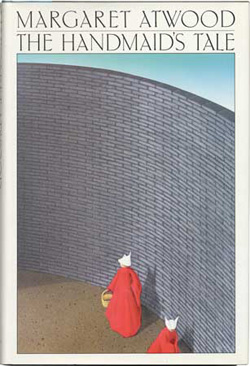
The Handmaid’s Tale is a disturbing, intriguing novel. It’s very much a novel of excellent prose and slight shifts rather than big explosions, and you need to be digging into every word as you read, but the experience is well worth it. My only qualm is the needlessly ambiguous ending, especially since any actual doubts are resolved in the epilogue.


The first Black Company novel in the omnibus was interesting due to the writing’s simplicity and the world’s refreshing amorality, but I wasn’t totally sold on the series. I can’t say that I’m a total convert yet, but Shadows Linger went a long way toward winning me over. My main gripe with the first volume, the highly episodic nature of the plotting, is absent here, and the character of Shed gives the story some variety. I have no idea how Cook’s going to bring this to a close in just two hundred or so pages, but I guess I’ll find out when I read White Rose next month. Look for a review then.


I’ve heard again and again that Malazan gets worse as it goes along, and I know two or three people who dropped the series at Reaper’s Gale, and yet it’s having the opposite effect on me. I didn’t fall in love until House of Chains, and each successive volume seems to just drag me deeper. This volume wasn’t perfect, of course (none of the Malazan books are even close to that), but like with all the other volumes, there are enough jaw dropping positives to overpower the occasional cringe worthy negative. I’m going to try and wrap up the Malazan series in a grand series of reviews once I get caught up.


Mad Ship is even better than Ship of Magic, and Ship of Magic in turn was even better than Farseer. At this rate, Liveships is going to quite possibly become my favorite trilogy. The characterization is just as good here, the world is broad and interesting, and the plot will occasionally surprise the hell out of you…though it probably wouldn’t have helped if the back cover didn’t reveal the first few hundred pages of the book quite so glibly. Look for my review once I finish the trilogy.


I’ve said it before (to myself, if that counts) that Stephen King is the best modern horror author there is (though I haven’t read nearly enough to properly make that statement), and that The Shining is his best novel (there I think I can qualify, having read over twenty of ‘em). I’ve been truly terrified by three stories – and I mean terrified, not kinda uncomfortable or whatever the hell most horror movies are shooting at – and the Shining has one of those three scenes. The horror, however, is far from the main part. Jack’s struggle with himself is torturous to watch, yet some of the best writing I’ve ever read. The ending is awful, but compared to some of King’s others it’s only kinda-awful, so I guess we’re lucky there. If you haven’t read the Shining yet, you’re missing out.


I have no idea why I picked Stephen King’s latest short story collection, when his earliest was stocked right next to it, no less, but I did, and I really wish I hadn’t. Everything’s Eventual is the first time that I’ve been truly disappointed by King, but damn did it hurt. My complete review is here.


The City and the City is a bit of an outlier for Mieville, but it succeeds at what it set out to do with ease. The book’s cornerstone, the two overlapping cities and their mutual ignoring campaign, is thought provoking and well handled, and the cinematic prose style (as in a lack of interior thoughts, not a lot of explosions) conveyed the atmosphere quite well. Unfortunately, both of those are interesting techniques that don’t make for easy reads. In addition, the ending, while technically filling all of the holes, was more than a bit disappointing. Though I don't necessarily agree with his conclusions, James has a good review of this up that should let you get a decent idea of the contents.


You know when you’ve built your expectations about something to the point where you know it’s going to disappoint you? And then it surpasses even those? Yeah, that’s what happened with Terminal World. It’s not a perfect novel, but it’s impossible to predict and written with a ridiculous amount of panache. If I were to compare it to something, I’d say that it’d be an odd mixture of Century Rain, Mieville’s bibliography. If you like Reynolds, you need to read this. If I succeed in composing my thoughts, I’ll write a review of this in a week or two. Until then, I'll contrast the Wert review I posted earlier with the Walker of Worlds one that I just read. Though some of the things he disliked were precisely why I loved the book, the review's quite informative and should give you a good idea of what you're getting into. UPDATE, I've now reviewed this here.


Old Man’s War was a fun, easy ride that had some intriguing ideas under its hood. The whole experience was slightly marred, however, by occasional clichés (which aren’t helped by Scalzi’s pointing them out) and a few scenes that are just too over the top to be effective. If you’ve read the book, you know what I mean. Hint: it involves Lilliputians. Still, I’ll be reading more of Scalzi’s work without a doubt. If you want a more comprehensive look at the novel, check out Aidan’s review. For a glimpse of some more of the novel's faults, go here.


This was absolutely delightful. The play is laugh out loud funny at several points, and the underlying ideas are brilliant. I only have two regrets: 1. That I couldn’t see it performed, and 2. That I didn’t get a chance to write down some of the passages before having to return my copy.


Not every story in this collection works, but every story tries something new and imaginative. There are three main story cycles here, as well as a few miscellaneous pieces, and all three are quite varied. The collection contains little in the way of new Ambergris material, though that’s not to say none, but the Incan stories are completely new and quite intriguing. Though I’d already read the majority of the Veniss stories in Veniss Underground, I was far more impressed the second time around, and I think my older treatment of them was more than a tad superficial. VanderMeer has yet to disappoint me, and he certainly didn’t do it here.