Showing posts with label John Scalzi. Show all posts

Sunday, April 10, 2011

Reading in April

April was a rather slight month for me when it comes to quantity. In part, that's due to the length of some of the books, but, more, it's the result of me reading a large number of magazines (Weird Tales, Asimov's, Analog, and Ellery Queen Mystery Magazine) in the middle. In an attempt to make my short story coverage more sensible, I'm no longer going to keep track of the magazines so much as the stories themselves, something that's taking far longer to do than I thought and will have to wait till next month to debut. But enough about things that nobody besides I and my I-should-be-using-Excel word documents care about. Let's get to some books…

Cold Hand in Mine was my first experience with cult horror author Robert Aickman, and it wasn't a disappointment. Aickman writes understated but magical stories, tales that aren't horrific in the slightest but are, instead, unsettling and profound from start to finish. Review coming up.
Great Expectations surprised me. Though I've often heard Di-ckens described as a clever writer, I was still expecting a dry "classics" read. Instead, I got prose that sang with wit, even if it was often bogged down. I found that the middle dragged fiercely, but the book was still quite enjoyable over all.
This is the conclusion to the Malazan series, a series that – as longtime readers know – I have quite an affinity for. I would not say that The Crippled God is my favorite volume, nor would I even say it is particularly close to that honor, but I did find it a quite satisfactory conclusion, filled with the grandeur, tension, awe, and depth that I expect when I begin one of Erikson's tomes. If there were to be no more Malazan novels, I would be sad but would not feel cheated. I will be rereading Malazan in the future, and will be covering it in some fashion, though I'm unsure exactly what shape that coverage will take.

Kiernan's writing is dark, lurid, and vivid. Her stories are composites of desire, lust, and decay, and they're filled with lush imagery that begs to be savored. Review coming.

The Wise Man's Fear functions in much the same way as The Name of the Wind. The prose is lyrical and fantastic, the story is as involving as could be, and the plot stutters and staggers over little ground. Review coming.
As always, Scalzi is amusing here. The novel is a mixture of wit, pulse pounding action, intrigue, and insightful social commentary. All that being said, there's still something holding me back from fully loving Scalzi, and I don't think it's a quantifiable thing. His writing and ideas are slick and enjoyable, but they're not something that I can fall for unreservedly. Still, this is recommended and, I think, highly unlikely to disappoint.

The Other is a powerfully written and involving horror novel. The characters and setting come to life through Tryon's prose. The reveal in the third act, and the climax, are breathtaking, though the tension before that does, perhaps, rise too slowly to be wholly effective. Still, this is an interesting and powerful read that's well worth checking out if it sounds interesting to you.

Monday, January 17, 2011

Reading in December

Well, I'm only seventeen days late on this recap, so it's practically breaking news. Quite a few of the books have already been discussed in the various year end post, and many of them will be receiving reviews shortly, so I don't always go into that much detail here. December was my second most productive month when it comes to reading, though almost a  third of the sixteen books were from two authors (Thomas Ligotti and Haruki Murakami), which is pretty unusual for me.


 This was the Westeros book club book of the month.  The first thing that must be known about Banville, is that his prose is excellent:

We presided over this rabble, Daphne and I, with a kind of grand detachment, like an exiled king and queen waiting daily for words of the counter-rebellion and the summons from the palace to return. People in general, i noticed, were a little afraid of us, now and again I detected it in their eyes, a worried, placatory, doggie sort of look, or else a resentful glare, furtive or sullen. I have pondered this phenomenon, it strikes me as significant. What was it in us- or, rather, what was it about us that - that impressed them? Oh, were are large, well-made, I am handsome, Daphne is beautiful, but that cannot have been the whole of it. No, after much thought the conclusion I have come to is this, that they imagined they recognized in us a coherence and wholeness, an essential authenticity, which they lacked, and of which they felt they were not entirely worthy. We were - well, yes, we were heroes. (p. 10-11)

The second thing that must be known about Banville is that, in his haste to combine Crime & Punishment with postmodernism, he completely misses the dilemma of Crime & Punishment and ends up with a well written but meandering book devoid of thought provoking questions.


 The Big Sleep had excellent pacing and prose. The plot, while fast paced, managed to also be meandering and twist itself into dead ends fairly frequently, but Marlowe's character made up for that quite handily. For my first foray into Crime, this turned out to be a great choice.


Stonewielder is the best of Esslemont's Malazan novels. Which, given my thoughts on Night of Knives and Return of the Crimson Guard, might not be saying all that much. Review coming.


I already talked about Preludes & Nocturnes in my Best Reads post, so I won't really do so here, but I will say that it was simply fantastic. If this is the weakest volume in the series, as I've heard quite often, I'm damn excited for the rest.


Fast, fun, and absurdly violent. Review coming.


Like a lot of classics, the Metamorphosis had the problem that I've seen every single scene go on to closely influence three others and be parodied four times, meaning that there wasn't a single unexpected blow in the story. And yet none of those pastiches or parodies had Kafka's humor, which, for me, made the story.


Seeing as I wrote my longest review to date on the book, I won't speak more here besides to just say that I found it thought provoking and extremely well written.


Ligotti is one of my favorite authors, and this is perhaps his best collection. I talked about this in my Best Reads piece, and I'll have a review up before too long.


Like most Ligotti, I read Teatro Grottesco twice. As for how it was…see former comment.


As evidenced by it making my Best Reads list, I loved After Dark. Review coming.


The Wind-Up Bird Chronicle was extremely interesting, but it was also extremely unfocused and is my least favorite of the Murakami I've read so far. Review coming.


Agent to the Stars was snarky fun through and through. Some events of the ending were a tad convenient, but the laughs never stopped, and, somewhere between them, Scalzi also managed to make me care. This is worth checking out, though don't expect a masterpiece.


Of the Shakespeare I've read, King Lear might be my favorite. Not much point in commenting further on something so discussed in so short a space, so I'll leave it at that.


A Thousand Acres – essentially a modern day take on King Lear – has a very powerful and affecting emotional core. Unfortunately, it also has a huge amount of slow moving scenes that served, for me, to dull the impact to some extent. It was, in the end, an enjoyable read, though I was very hesitant for the first third or so.


 Like with Oedipus and The Odyssey, my main reaction to Antigone was astonishment that something written so long ago could be read so easily. I preferred Oedipus (read a few months back), but this was still an interesting read.


I talked about this in my Best Released list, but the prose is so good that it's worth repeating the comment: Valente's prose is mind blowing. It's a flood of images that's easy to drown under, but you'll be enthralled for every second of it. 

Friday, November 5, 2010

Black Halo and Fuzzy Nation [Cover Art]


The cover for the sequel to Tome of the Undergates is a tad over the top. Still, it's, as far as I'm concerned, the way an overly epic cover should be done. If you're going to go over the top, you might as well go absurdly, stupidly, awesomely so. My only real objection is the glow around the figure, as it seems a tad too pronounced for me.


The new cover art for Scalzi's re-imagining of Piper's Little Fuzzy is very different from the original cover art for the project. Overall, I think I liked the first version more, but I don't dislike this one, and I'm intrigued enough by the idea of the project to read both the original and it when it comes out.

Friday, April 9, 2010

Rebooting the Classics

Recently, John Scalzi announced that he has written a “rebooted” version of H. Beam Piper’s Little Fuzzy. Now, I have a decent amount of faith in Scalzi. I’ve only read Old Man’s War by him, but it was quite good, and I’ve read a slightly ridiculous amount of Whatever over the past few weeks. I don’t think that Scalzi is going to start producing hackwork any time soon, but Scalzi isn’t the whole field, and, as Pride and Prejudice and Zombies proved, unique ideas stay unique for roughly as long as it takes for the first reader to pick up a copy. Anyone who can’t see the potential for ludicrous amounts of derivate dross in these reworkings is mind bogglingly optimistic, but what actual impact is this likely to have on the genre?

Let’s stick with the Spliced fiction (ala Pride and Prejudice and Zombies) for a bit, as it’s quite similar to this new (potential) phenomenon. Neth recently posted some musings on his blog, and I think he raises most of the important points. It’s a fun concept, sure, but is it actually worthwhile? I can’t give you a definitive answer, and I’d be lying if I said I was well read in the new fad. I do, however, think that it’s something that could have potential…but, in order to reach that potential, they’ll need to do more than just mash two things together. As it is, for the most part, Spliced fiction is taking an old idea, leaving it entirely unchanged, and then sticking on some flashy disco lights to obscure the fact that you haven’t done shit in the way of actual innovation. Entertaining, sure, but not exactly groundbreaking. If any of these new authors want lasting success, they’re going to have to create something more than a comic idea. It’s the same as with Science Fiction. You can’t just say “my book has a spaceship,” and expect it to sell. You have to do something with the spaceship, and so far I remain unconvinced that anyone’s actually done anything with the spaceship in all these Spliced stories.

I have a bit more faith in the merit of near future Rebooted fiction. This type of thing is relatively unheard of in fiction, but is commonplace just about everywhere else. One of the most obvious comparisons is the tribute song. The vast majority of tribute songs are simply a note for note reproduction of the original, generating the same feelings if well done, but not adding anything. The players of these songs, however, aren’t trying to add anything with their covers. It is, in general, more to show an artistic debt than anything else. This kind of cover is analogous to the fan fiction that’s always existed. Entertaining, and a good building block for other things, but not noteworthy – nor likely to ever really impact the field –on its own.

The second kind of tribute, however, is a totally different ballpark. This is the kind of cover in which the covering band doesn’t just replay the song, but reinvents it. Excellent examples of this include Jimi Hendrix’s cover of Bob Dylan’s All Along the Watchtower and Judas Priest’s cover of Joan Baez’s Diamonds and Rust. These covers are not so much a regurgitation of the original idea but a reenvisioning of it through a new perspective. If this concept was extended to fiction, as Scalzi seems to intend, I see no problem with it at all.

So, why have neither of those styles of tributes ever caught on with fiction? Well, alright, there have been a few examples, but all of them have been on the fringe of Scalzi’s Rebooting and nothing closer. The most obvious of those, at least to me, is the continuation of the works of Robert E. Howard and HP Lovecraft after the authors’ death. The difference there is that those stories are extensions of the authors’ work, not revisions of it [see comments for an expansion on this by Taraniach]. Moving away from exceptions, the reason that these revisions have never done much in fiction is that their main cause is gone. In video games and movies, fields where this kind of thing is common, the primary reason is technology. You may debate the degree, but it’s impossible to say that graphics and the like do not impact the experience at all. Newer gamers, say the people who started on an Xbox, are going to have a damn hard time going back and playing older games, regardless of their quality. As a result, revisionists get their chance to shine every few years as they raid the graves of past giants for a new audience.

In books, however, there’s nothing like technology to necessitate revision. Yes, language changes, but not to the degree that you’re going to need to translate The Hobbit anytime soon. What does this mean? Well, barring a few oddballs, I’m hoping that the majority of these Reboots will be done out of a love for the original work, and a belief that it can be altered in some way, rather than because seventeen, or two hundred and six, years have passed.

Overall, the reason that I’m confident the market won’t be flooded with revisions is, in part, what I just mentioned. I don’t think it’s going to be all that much of a cash cow, because there’s very little reason for a reader to pick up a newly written copy of A Red Badge of Courage over the original. People have proven that they have absolutely no problem paying again and again for something that’s just like Tolkien, but I have a hard time believing that they’ll pay the same amount for something that is Tolkien. Or perhaps I’m just being a bit of an optimist here.

Wednesday, March 31, 2010

Reading in March

Even doing a review a week, there's no way I can get through all the books I want to get through. There is, of course, no obvious NEED to review everything I've read, but I feel like I should at least mention most of it. I'm not doing this (purely) in a masturbatory, look-what-I've-read fashion, but hopefully also giving you a rough idea about the books I don't have time to talk about in a more developed fashion. I'll also link any reviews I've done for the books, as well as any outside reviews that I found particularly worth reading. So, without further ado, what I read in March:


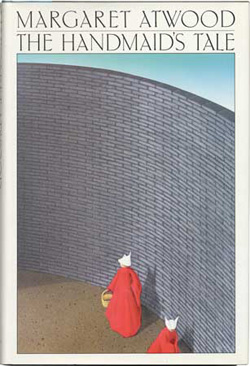
The Handmaid’s Tale is a disturbing, intriguing novel. It’s very much a novel of excellent prose and slight shifts rather than big explosions, and you need to be digging into every word as you read, but the experience is well worth it. My only qualm is the needlessly ambiguous ending, especially since any actual doubts are resolved in the epilogue.


The first Black Company novel in the omnibus was interesting due to the writing’s simplicity and the world’s refreshing amorality, but I wasn’t totally sold on the series. I can’t say that I’m a total convert yet, but Shadows Linger went a long way toward winning me over. My main gripe with the first volume, the highly episodic nature of the plotting, is absent here, and the character of Shed gives the story some variety. I have no idea how Cook’s going to bring this to a close in just two hundred or so pages, but I guess I’ll find out when I read White Rose next month. Look for a review then.


I’ve heard again and again that Malazan gets worse as it goes along, and I know two or three people who dropped the series at Reaper’s Gale, and yet it’s having the opposite effect on me. I didn’t fall in love until House of Chains, and each successive volume seems to just drag me deeper. This volume wasn’t perfect, of course (none of the Malazan books are even close to that), but like with all the other volumes, there are enough jaw dropping positives to overpower the occasional cringe worthy negative. I’m going to try and wrap up the Malazan series in a grand series of reviews once I get caught up.


Mad Ship is even better than Ship of Magic, and Ship of Magic in turn was even better than Farseer. At this rate, Liveships is going to quite possibly become my favorite trilogy. The characterization is just as good here, the world is broad and interesting, and the plot will occasionally surprise the hell out of you…though it probably wouldn’t have helped if the back cover didn’t reveal the first few hundred pages of the book quite so glibly. Look for my review once I finish the trilogy.


I’ve said it before (to myself, if that counts) that Stephen King is the best modern horror author there is (though I haven’t read nearly enough to properly make that statement), and that The Shining is his best novel (there I think I can qualify, having read over twenty of ‘em). I’ve been truly terrified by three stories – and I mean terrified, not kinda uncomfortable or whatever the hell most horror movies are shooting at – and the Shining has one of those three scenes. The horror, however, is far from the main part. Jack’s struggle with himself is torturous to watch, yet some of the best writing I’ve ever read. The ending is awful, but compared to some of King’s others it’s only kinda-awful, so I guess we’re lucky there. If you haven’t read the Shining yet, you’re missing out.


I have no idea why I picked Stephen King’s latest short story collection, when his earliest was stocked right next to it, no less, but I did, and I really wish I hadn’t. Everything’s Eventual is the first time that I’ve been truly disappointed by King, but damn did it hurt. My complete review is here.


The City and the City is a bit of an outlier for Mieville, but it succeeds at what it set out to do with ease. The book’s cornerstone, the two overlapping cities and their mutual ignoring campaign, is thought provoking and well handled, and the cinematic prose style (as in a lack of interior thoughts, not a lot of explosions) conveyed the atmosphere quite well. Unfortunately, both of those are interesting techniques that don’t make for easy reads. In addition, the ending, while technically filling all of the holes, was more than a bit disappointing. Though I don't necessarily agree with his conclusions, James has a good review of this up that should let you get a decent idea of the contents.


You know when you’ve built your expectations about something to the point where you know it’s going to disappoint you? And then it surpasses even those? Yeah, that’s what happened with Terminal World. It’s not a perfect novel, but it’s impossible to predict and written with a ridiculous amount of panache. If I were to compare it to something, I’d say that it’d be an odd mixture of Century Rain, Mieville’s bibliography. If you like Reynolds, you need to read this. If I succeed in composing my thoughts, I’ll write a review of this in a week or two. Until then, I'll contrast the Wert review I posted earlier with the Walker of Worlds one that I just read. Though some of the things he disliked were precisely why I loved the book, the review's quite informative and should give you a good idea of what you're getting into. UPDATE, I've now reviewed this here.


Old Man’s War was a fun, easy ride that had some intriguing ideas under its hood. The whole experience was slightly marred, however, by occasional clichés (which aren’t helped by Scalzi’s pointing them out) and a few scenes that are just too over the top to be effective. If you’ve read the book, you know what I mean. Hint: it involves Lilliputians. Still, I’ll be reading more of Scalzi’s work without a doubt. If you want a more comprehensive look at the novel, check out Aidan’s review. For a glimpse of some more of the novel's faults, go here.


This was absolutely delightful. The play is laugh out loud funny at several points, and the underlying ideas are brilliant. I only have two regrets: 1. That I couldn’t see it performed, and 2. That I didn’t get a chance to write down some of the passages before having to return my copy.


Not every story in this collection works, but every story tries something new and imaginative. There are three main story cycles here, as well as a few miscellaneous pieces, and all three are quite varied. The collection contains little in the way of new Ambergris material, though that’s not to say none, but the Incan stories are completely new and quite intriguing. Though I’d already read the majority of the Veniss stories in Veniss Underground, I was far more impressed the second time around, and I think my older treatment of them was more than a tad superficial. VanderMeer has yet to disappoint me, and he certainly didn’t do it here.