Tuesday, February 23, 2010

Stephen King - Carrie

If only it would be today and Jesus coming not with a lamb and a shepherd’s crook, but with a boulder in each hand to crush the laughers and the snickerers, to root out the evil and destroy it screaming – a terrible Jesus of blood and righteousness.

And if only she could be His sword and His arm.


Everyone has, no doubt, heard of Stephen King and his first work, Carrie, and yet it is paradoxically easy to distance oneself from the giants in the field. After a point, it’s easier to think of everyone on the subway holding a newly released copy of Under the Dome than it is to remember the realities of King’s writing. When I began Carrie, my first King novel in two or so years, I was immediately reminded of all the reasons that I read twenty of his novels in a period of just under three months. By the time I finished Carrie, I also remembered the annoying aspects of King’s writing that are just as much a part of his style as the positive parts.

Carrie is a mercilessly mocked misfit that comes to embody supernatural revenge through her latent telekinetic powers. The structure of the story is built entirely around a single massive set piece. The events are deserving of the focus lavished on them, but the extensive early foreshadowing serves to dampen any sort of surprise. The novel is told through an untold number of viewpoints, both pseudo-nonfiction and a standard third person. This cornucopia of perspectives leads to both great and terrible things. On the upside, we come to sympathize with (almost) every side of the equation, and therein lies the novel’s greatest strength. On the downside, the pacing of the book is often slowed down at critical moments. Learning about a man running terrified as he’s pursued by what feels like every demon of hell personified in an endlessly wronged schoolgirl? Awesome. Learning about sixty of them for every street that Carrie crosses? Not so much.

The strength of the novel comes from the characters, and the star of the cast is, of course, Carrie White. The number of truly innocent characters in fiction is fairly low, but Carrie is without a doubt one of them. She is both naïve and cynical, both pitiable and, by the end, reprehensible. In her character, King has taken a phenomenon as common as anything else in the world – the outsider, mocked by the whole for being different – and turned it into a tragedy as personal and as unjust as any global atrocity.

Of the other characters, most manage to come to life through their dilemmas and problems. Undoubtedly the greatest of the secondary characters is Sue Snell, who tries to right the wrongs done to Carrie. Of course, she’s far from black and white. She was there along with everyone else, taunting Carrie, and only now does she feel the cruelty of what she did. Often, it’s impossible to tell whether her actions are motivated by a newly found compassion, or whether they’re merely empathy in the guise of selfishness. And it’s not just that we don’t know, the character doesn’t either, and she admits it.

The only character that really falls flat is Carrie’s mother, Margaret White. For the first, but certainly not the last, time in his career, Stephen King investigates religion, this time in the guise of Margret’s zealotry. Unfortunately, this is probably his worst treatment of it. The early glimpses of her views are disturbing, but you soon come to the realization that there isn’t much under the surface, and some of the more outrageous aspects make the entire affair seem kind of silly. Dirtypillows, for instance, are just not a very frightening, nor realistic, term for breasts. I mean, fine, sexuality’s evil, but I just have trouble conceiving of the sheer act of puberty being sinful.

King’s prose in Carrie is similar to his writing throughout his career: down to earth and easy to follow. It’s easy to imagine these events taking place in some nearby small town, and King’s diction is a definite part of that. His writing feels like the raw speech of the average man and as such conveys a sense of time and place like few others are able to. The most interesting element in it here is his conveying of thoughts – often contradictory to the majority of the prose – in parenthesis, such as:

Carrie tried to swallow an obstruction and only
(i am not afraid o yes i am)
got rid of part of it.


Carrie isn’t flawless, but its successes – primarily the characterization of Carrie White – are so powerful that you’ll be haunted for days to come. Without the faintest aura of pretension, Stephen King manages to show the reader something about the consequences of their actions on others. Highly recommended, if you’re in the mood for a bleak novel that may just show you some things about yourself and your interactions that you didn’t wholly realize.

Tuesday, February 16, 2010

Steven Erikson - Bauchelain and Korbal Broach

Manservant required. Full time. Travel involved. Wage to be negotiated depending on experience. Call at Sorrowman’s Hostel.

Steven Erikson’s Bauchelain and Korbal Broach novellas are at once everything you’d expect and nothing at all like what you think you’re getting. In Memories of Ice, we’re briefly introduced to the enigmatic Bauchelain and the mildly sociopathic Korbal Broach. One is tall and suave; one is short and kinda insane. Both are incredibly powerful. What we get in Memories of Ice is never more than a taste, and it was obvious there was far more under the surface. I came to this collection expecting to have the cloth pulled back. I wanted to see figure out who these people were, and I wanted to see what they got up to when they weren’t messing with caravan guards. The second is satisfied in spades. The first…not so much.

Erikson’s style here is fairly different from his more epic works. The novellas are, by necessity, far more focused than their gargantuan brethren, and Erikson proves himself more than capable at telling a concise story. In addition, his talent for easily understood, yet chaotic, action is present in full force, abetted by his usual grasp of atmosphere.

“Every child should know terror, and are not my little ones terrible?”

Though humor has always been a part of the Malazan books, it’s never played nearly as central a role as it does here. In addition, while the jokes in Midnight Tides, etc, are almost wholly dependent on clever phrasing and wording, here Erikson takes a far more slapstick approach. If you’re easily offended, you might want to stay well clear. Erikson knows what he wants to convey, and he spares no punches when doing so. You’ll laugh, but you also just might feel the tiniest bit queasy as well.

The first novella is Blood Follows. It is exactly what I was expecting, a phenomenon no doubt aided by Memories of Ice giving away the ending and the back cover giving away the beginning. The killers are obvious from the first page, but everything falls together perfectly for a time. And then, before getting to delve into the psyche of the two, the story comes to a conclusion both abrupt and unsatisfying. Ah well, I thought, all will be revealed in the next.

It was not to be.

What follows is just over two hundred pages of murder and laughter. Now, that hardly sounds so bad, and it’s not. It’s just that I was expecting something more. The whole experience is roughly akin to sitting down to watch an anticipated movie: the beginning is highly promising, doing nothing but whetting your appetite…and then comes an hour and a half of a protracted gun battle, with a few car chases sprinkled in the middle for variety. It’s entertaining, sure, but it’s not particularly satisfying.

The Lees of Laughter’s End reads like the climax of your average fantasy. From the first few pages on, we get to witness the supernatural slaughter of just about everyone and everything on board the Suncurl, but without any context or real depth, the procession of murdered crew members never compels a real reaction. In the past, Erikson’s novels works partly because they’re such a mess. The Chain of Dogs was nothing but a string of climactic battles, but spaced out amongst other, less explosive narratives, and it suddenly worked. Here, there’s no breather room whatsoever, and the narrative soon becomes nothing but tiring.

The third novella, The Healthy Dead, is not quite as overwhelming as The Lees of Laughter’s End. Breakneck pace and scattershot plotting still dominate, but the whole affair is far more focused. Primarily, this is a brutal satire of healthy living, a fact that’s perfectly clear from the introduction: WARNING TO LIFESTYLE FASCISTS EVERYWHERE. DON’T READ THIS OR YOU’LL GO BLIND.

Bauchelain and Korbal Broach is a decently entertaining read, but not much more. In his central Malazan novels, Steven Erikson succeeds and conveying character depth with a mere handful of pages. Here it is the opposite. In three hundred pages dedicated to the scheming sorcerers and their diabolical manservant, we never learn a whit more about them than we did at the end of Memories of Ice.

If you want a good time, don’t hesitate but don’t expect anything particularly mind blowing. A new novella was released recently by the name of Crack’d Pot Trail, but as much as I love the mainstream Malazan novels, I have to admit that I’m going to wait for the other novellas to be collected in paperback form before purchasing them.

Thursday, January 28, 2010

Robin Hobb - Farseer

All too often I find I have wandered far from a history of the duchies into a history of FitzChivalry. Those recollections leave me face-to-face with who I once was, and who I have become.

Robin Hobb is, in many ways, a one trick pony. Wait, wait! Don’t leave yet. I don’t mean that in a particularly negative way. There’s nothing wrong with the majority of her style; it’s just utterly overshadowed by one aspect. She has less in common with a dog standing on its high legs and more in common with a dog learning to drive a racecar.

As anyone who’s ever read Hobb can likely attest, her strength is not plot. Farseer’s plot is, ultimately, fairly generic. There is an abandoned bastard son, brought to the castle to serve as an assassin. There are three brothers, two honorable and brave, one spiteful and cowardly. There are barbarian raiders from another land, and there are magics both old and very old. Have I intrigued you yet? No, I thought not.

Her strength is not setting. We’re in the Six Duchies, a confederation of six former states, all ruled under one king. The coastal Duchies fish; the inner Duchies farm. There is conflict between the two; the coastal Duchies are reluctant to pay taxes to defend a coastline they do not share. It’s thought out better than most of its ilk, I’ll admit, but it’s still not exactly the kind of thing that you view with your jaw on the floor.

Robin Hobb’s strength is character. It’s not an intellectual strength; I’m not talking about revolutionary backstories, or motivations, or anything like that. Her strength is visceral. These people feel real in every way possible. We see Verity trying to fill his older brother’s shoes, trying to guard the kingdom. He does everything he can, and he is wasting away, and it is not enough. We see him, and we know that he cannot succeed, and he knows he cannot succeed, and yet he cannot – will not – stop.

Fitz is the main character, the aforementioned bastard son of Price Chivalry. He has a depth that can only be had when the reader experiences his growth alongside the author, alongside the character. When we first meet Fitz, he is a blank slate:

My memories reach back to when I was six year old. Before that, there is nothing, only a blank gulf no exercise of my mind has ever been able to pierce. Prior to that day at Moonseye, there is nothing. But on that day they suddenly begin, with a brightness and detail that overwhelms me...

It’s said that our experiences shape us, and so it is here. We experience everything that Fitz does, and so is it that surprising that we are shaped in the same way the he is? In book one, we see Fitz develop loyalties in friendships. In book three, these loyalties are tested. The reader cannot look on with detachment, cannot wonder if he will stand fast or not. There is no intellectual contemplation, no thoughts that he should simply bite the bullet and move on. By that point, it is not Fitz that is being tested, at least not wholly. The reader is invested along with him. Every bond that Fitz forges is shown with meticulous detail, and the reader himself becomes friends with Prince Verity, Molly, and Burrich. These friends may not speak to us directly as we read, but there interactions with Fitz are, on every level that matters, interactions with us.

We become so deeply immersed with Fitz that his reasoning becomes our own. I would wager that everyone has had the unsettling experience of having someone tell us our own motivations and realizing that what we thought we were acting for was just blissful, comforting delusion. It is the same experience when Fitz’s motivations are called into question. Acts that felt so pure at the time are suddenly given new light, and we feel almost sullied as we contemplate them afresh.

A large portion of your enjoyment of Farseer depends on how much you like to meander. Hobb is anything but direct. I’ve heard it said that her writing is eighty percent filler, and it’s hard to really dispute that claim. All the same, I think that it’s the so called filler that makes Hobb worth reading in the first place. The reader lives through Fitz’s life, and I do not mean just the important moments. No, the books – and Hobb – shine through the monotony of day to day existence. If you are willing to simply cut yourself loose, to lose yourself in Fitz’s existence, you’ll find yourself living a life no less complete and complex as your own.

I suppose that that is, quite literally, escapism. All the same, I’ve never understood the term completely. It’s defined as: “Habitual diversion of the mind to purely imaginative activity or entertainment as an escape from reality or routine.” I suppose I can’t argue with that, but the term seems to far more often carry a negative connotation. I’ve often heard it said that it’s taking refuge from the real world. Ignoring the tone of the novel in question, something has never struck me as accurate about this definition. Just because what we’re doing does not directly tie into our own lives, why is it inherently meaningless? I’m not defining meaning as a simple recharging of the batteries here, either, though it can do that too. But books can do so much more. Who says that, just because the terms in question are not those of the real world, we are not learning, are not experiencing?

Besides which, if I was going to escape to somewhere else – a Hawaiian vacation for the soul, say – I’d make it somewhere les depressing. The titles and covers all seem quite carefree, but the actual text is anything but. This is, despite all appearances to the contrary, anything but standard fantasy. We are in Fitz’s head for his triumphs, yes, but also for his tragedies, and we feel both with equal force. Just because Fitz tries something, and just because Fitz is one of the “good guys,” does not mean that he will succeed. Be prepared for disappointment of the most bitter flavors while reading.

“I always believed, perhaps childishly, that if you followed the rulers, you would be protected, that things like that would not happen to you. Afterward, I felt…tricked. Foolish. Gullible, that I had thought ideals could protect me. Honor and courtesy and justice…they are not real, Fitz. We all pretend to them, and hold them up like shields. Against those who have discarded them, they are no shields at all, but only additional weapons to use against their victims.”

Of the individual books, the first is at once the one with the fewest flaws and the weakest. The second, by contrast, has glaring problems, and yet it’s undoubtedly my favorite. The first book lays down the connections, and it is half the size of the others. It’s not focused, no, but it never meanders too much, and we always have our ending goal in sight.

The second, on the other hand, is almost nothing but meander. It’s an attempt to preserve the status quo as seen in book one, but for half the text exactly how we’re doing so is quite hard to see. That being said, Hobb’s writing gets better as it goes on, and every interaction between Fitz and another character only makes the overall story that much deeper.

The third novel is an odd mixture of the two. It should, by all rights, be the most driven. A goal is immediately established, and Fitz sets out to accomplish it. Perhaps because of this, it’s the first time where the repetitive nature of the story began to become somewhat irksome. When there’s no set destination, I’m fine with exploring every little town that I pass on a long drive. When I’m late for something, however, I’m far more tempted to ram the pedal to the ground and get somewhere. This is not an urge that Hobb shares, and the cycle of Capture-Escape goes on to the point of insanity. At which point we’re finally given a break, and the book takes a hard right turn. Everything changes, and it’s at once totally brilliant and anything but. The ending is powerful, yes, but also rushed. As it is, it’s a decent closing to a brilliant series, but it’s impossible to shake the feeling that it could’ve been an amazing ending.

If you’re looking for something exciting, or something uplifting, Farseer is not for you. This isn’t about a gripping plot or fascinating locales. This is about people living their lives, and, though it’s fantasy through and through, Fitz and Hobb’s other creations feel as real to me as anyone I know. If character driven is what you’re after, I’m not sure it’s possible to do better than this.

Tuesday, December 8, 2009

Jeff VanderMeer - Veniss Underground

Let me tell you about the city…

I don’t think that I’ve ever been this floored by a novel (A Storm of Swords at least had the dignity to come with a warning label in the form of the prior two volumes). VanderMeer is an author whose name seems to be pretty universally revered, when recognized, amongst SFF fans. For what feels like months, I’ve been looking for A City of Saints and Madmen. After having my search thwarted by every bookstore in Long Island, Rhode Island and Massachusetts, I finally found Veniss Underground in a college bookstore just before giving up hope. I had never heard of it, but by then I was willing to try anything with VanderMeer’s name, or a close approximation of it, on the spine.

The book was, as can be inferred by the first sentence, stunning. It’s set far in the future, in a time when earth’s various cities have become high tech city states. For a time, Veniss enjoyed a golden age, but, for causes unspecified, the city’s government came crashing down. In its absence, the various districts of the city have become independent in their own right, and the city’s underground is spilling into daylight. Though he is only visible for a brief time, Quin is the catalyst of the entire book. It is his influence that sets every one of the characters on their path.

The glory of the book doesn’t come from the plot. It’s in the prose and characters that the magic is truly found. Experimental techniques such as second person and its kind are viewed with – not undeserved – hesitation by most readers. It takes a book like this to remind us that it isn’t the techniques that are bad, just their continual misapplication. The writing here is filled with great phrases, yet remains clear throughout. Allusions to other literary works fill the story, Dante’s Inferno and countless other classics and myths prominent among them.

The book is structured in three parts of increasing length, one from each of the character’s perspectives. Different parts are each written in a totally different viewpoint style and vary considerably in atmosphere. The first of these is told by Nicholas. Despite being the reason that the rest of the characters are dragged down into the underworld, Nicholas’s screen time is quite brief. His chapters are written from a selfish first person perspective, and, as a failed artist and “slang jockey” are littered with turns of phrase that vary from insightful (The city is sharp, the city is a cliché performed with cardboard and painted sparkly colors to disguise the empty center – the hole), to amusing (replacing IE with Eye E, for instance), to downright pretentious (wait, listen: the end of the world is night; that’s mine, a single-cell haiku).

The second part of the book is told from Nicola’s perspective. Prose here is written in a second person, present tense style. This not only sucks you in beautifully, after a few seconds of adjustment, but also provides some of the best writing:

You. Were. Always. Two. As one: Nicola and Nicholas, merging into the collective memory together, so that in the beginning of a sentence spoken by your brother you knew the shadow of its end and mouthed the words before he said them.

The third part of the book is told from Shadrach, Nicola’s former lover. His style is told in a more detached third person perspective. Here, the eye grabbing writing is pushed farther back, to allow the outside world to shine through more clearly. For a few instants this transition seems like a shame, but the prodigal strangeness of the underworld makes up for it with ease. Shadrach’s section forms the largest portion of the book and from him we learn the most about Veniss, and about all of the characters. Prior misconceptions are set to rights, and there are two moments of brilliance that can best be described as the structural equivalent of a plot twist.

The underworld is strange in a way that few other fantasies have ever managed to be. It can, perhaps be compared to Mieville for sheer inventiveness, but the comparison comes more from the authors’ titanic imaginations than any true similarity. As the quest continues, and Shadrach descends from level to level, the strangeness becomes ever more profound. There are scenes of horror here, and scenes of wonder, and all of them are perfectly envisioned and conveyed.

Also contained in the volume are three short stories and a novella, all set within the Veniss milieu. The short stories are all interesting, but none approach the level of the preceding novel. The greatest of them is the third, A Heart For Lucretia. Its interesting structure, and bizarre chain of events, is captivating, yet the entire thing felt like it was perpetually on the edge of greatness, unable to cross over within its limited length.

The novella, Balzac’s War, is the best of the extra content. Like the shorts, it takes place far after the main story, and is centered on a war between humanity and the flesh dogs. The story begins with a brief scene, then jumps a large number of years. The reasons for that never become wholly apparent, but the story has strong characters and is highly unsettling nonetheless.

Veniss Underground is a story that draws you in and does not let you go, filled with memorable characters and troubling themes, evocative images and unforgettable action. It is not something that should be allowed to pass by. If you don’t have it, you have done a grievous disservice to yourself. Remedy that at once.

All of this leaves A City of Saints and Madmen with quite a bit of living up to do.

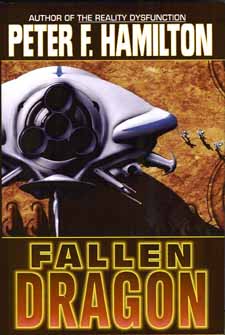
Peter F. Hamilton - Fallen Dragon

In the public conscience, the glamour of interstellar exploration was fading like the enchantment of an aging actress...

The quote, given to us within the first paragraph, sets the tone for the rest of the book. Within, Hamilton questions just how realistic our gilded dreams of colonizing the stars really are. The rose-colored enthusiasm of the early explorers is almost wholly gone by now, leaving in its place corporate domination. The common people want nothing so much as to be allowed to live their own lives.

Despite this interesting premise, the book has some serious problems. Most of these seem to come from a fundamental clash in just what story was being told. It’s a common reader complaint that whatever book they have just bought didn’t turn out to be what they were after, and it’s hard to blame anyone but them for their generally shoddy research. I don’t feel that’s the case here, however. It’s not just that the back promises one thing and the text delivers another, it seems like the two different strands of the story are constantly pulling against each other and trying to sprint off in opposite directions.

The first of these strands is, essentially, corporate piracy. Zantiu-Braun funded the colony’s development, now it feels it has a right to whatever the place has produced since. Backed by their Skin wearing super soldiers, the corporation has to face a determined resistance attempt on the world of Thallspring. In this, all three viewpoint characters – Zantiu-Braun’s Simon Roderick, resistance organizer Denise Ebourn, and Skin soldier Lawrence Newton – seem to be of roughly equal importance and are given roughly equal screentime.

The second strand, however, is solely about Lawrence Newton and his development. Now, Newton is a fascinating character. His idealistic dreams about exploration and space flight form an interesting contrast with those around him, and his life is suitably traumatic to be fascinating. All the same, this focus works actively against the first far more than it aids it.

The resistance plotline relies almost wholly on rising tensions. As the movement commits each isolated act, the population of the city is further emboldened and the Skins are increasingly nervous. Tensions rise consistently and everything would be fine - if only it wasn’t completely upset after every single chapter. The book is roughly split between Lawrence’s past and the current conflict, and every flashback totally severs whatever was built up in the chapter prior.

The first few flashbacks are closely related and manage to keep our interest for the next one reasonably high. But after that, just as the other storyline is ramping up, the scenes here grow further apart and more disconnected. The result is that the books pace starts to feel wildly uneven, as each chapter has to start from scratch and wholly rebuild the tension that its predecessor had already established. In addition, Lawrence’s life goes through so many different phases that it is some time before we receive any pay off within the present day at all from the interludes.

Tying into this is Hamilton’s methods of maintaining tension in his various mysteries. We are given a single hint, then no further clues for five hundred pages. At the last second, though, the mystery is busted out fully formed.

After all that, I feel I should probably state that the book is actually quite good. The technology is always interesting and inventive, as are the worlds that the characters visit. The plot always moves at a decent clip and remains quite reasonable throughout. Several twists and developments come as a total surprise, though in retrospect each is exquisitely foreshadowed. Don’t be surprised if you find yourself reading for hours at a time, on this one. Once Hamilton gets going, it’s damn hard to put down. The action scenes are near flawless, both adrenalin filled and packed with cool concepts and clever trickery. After making the Skin suites so powerful, one would think that Hamilton would have a hard time giving them worthy adversaries. On that front, there’s no need to worry.

The characters are a mixed bag. Well, that’s probably not the best term to describe them. They are, all save one, very well done. Which just makes that one exception all the more glaring. Lawrence Newton is the star of the show, and is the best realized character by far. All of his experiences eventually do tie who he is and his quest to finally attain his dreams of interstellar exploration is a joy to read about.

He isn’t the only character that is well drawn. At first glance, his squad mates, especially the newbie, Hal Grabowski, are all almost caricatures. Yet, somewhere amidst the man’s fourth and ten thousandth plea for sex, he came alive. Though it came as a shock while reading, I found myself genuinely caring when he got himself into trouble

The one flaw is Denise. For the vast majority of the book, we have a very solid character in her. The contrast between loving playschool teacher and ruthless resistance leader is excellent. In the course of her experience with small children, she tells them and us the story of Mozark. The story is a charming travelogue of sorts, filled with interesting descriptions and ideologies. Despite, or perhaps because, of how different it was from the rest of the book, it became one of my favorite parts:

“The planet’s true name had been forgotten centuries ago. It was just called The City now…The people who lived there had devoted themselves to making the most beautiful buildings it was possible to make. All of them lived in their own palace with a parkland and a lake and a river, and their public buildings were as majestic as mountains.

…after a time Mozark began to see it for the folly it really was. All the inhabitants of The City did was maintain their buildings. Some families had lived in the same place for twenty or thirty generations. They added to it, but never changed the nucleus, the essence that made them what they were…Mozark knew the people could be inspired to build beautiful or gigantic structures, but after that it was always time to move on. The city was magnificent, but decadent it celebrated the past, not the future."

Then, right before the end, Denise gives a big reveal. Her motivations change completely. The problem is, in a fairly tight third person perspective like this, we get to see her thoughts. All of them support the first course. The second, the supposed purpose of her life, isn’t dwelt upon in the slightest.

Among all these different characters, Hamilton certainly doesn’t shy away from the big issues. Weighty matters like systems of government and “ecocide” are debated at length. In and of itself, that’s hardly a new thing. What is refreshing, though, is the absence of any THIS IS THE RIGHT WAY declarations to close the argument. Hamilton is more than content to let his various characters make their points, and he allows those points to rise and fall on their own merits. That quoted passage up above, for instance? Undoubtedly against materialism, and yet it’s never confirmed by the hand of god/the author. In fact, several other characters would no doubt vehemently disagree with it.

I checked out Fallen Dragon after being intimidated by the length of the Night’s Dawn trilogy. In that respect, it served as an interesting entryway to Hamilton’s work, and I will be checking out the trilogy shortly. If you’re looking for a character driven science fiction story, filled with fascinating big ideas and awesome action, check it out…just don’t expect a perfect ride.

Mission Statement

There are a lot of review blogs out there. Amongst all of them, the sensible thing to do would be to try to differentiate oneself. That could be difficult, though. Amidst this many bloggers, mostly following the same general format, what can one do that will be truly original, while still remaining useful to the only part of the equation that really matters, the readers?

Whatever it is, I haven’t thought of it. I don’t have a single catchphrase that reveals – RIGHT THERE AND THEN – what I’m offering that no one else is. Popularity would be nice. I doubt all that many people would complain about being quoted on book jackets, or being courted by their favorite authors. I’m pretty aware that it’s not going to happen to me, at least not with a beginning as ambitious as this is proving to be.

Why am I doing this, then? Simple: I love to read, and I love to write. Over the years I’ve discovered that, when I read a book, I’m going to decide if I like it. I’m then going to decide why. I’m then going to share these reasons with someone else. This is something inalterable about me. I will find myself going over the merits of The Lies of Locke Lamora or Perdido Street Station with classmates who haven’t willingly read a book in years and who couldn’t possibly care much less.

Reviewing is, as far as I can tell, the obvious solution here. I get to take something that I was going to do anyway, and I get to get something out of it. If not piles of money, then at least something more constructive than endless IM conversations about the merits of The Gathering Storm or Chasm City.

So, I’m not offering anything particularly new, or innovative, or, in all likelihood, particularly worthwhile. All the same, it will hopefully prove interesting. If you have an interest in reading and would like to read a – hopefully thoughtful - take on books you’ve read, or are considering reading, perhaps I can provide it. Perhaps not. No harm done, in that case. If you are interested, know that from this point on (February 9th, to be exact) I'll post a new entry every Tuesday and will focus mostly on science fiction, fantasy, and perhaps a touch of horror.

I think I’ve blathered enough here – you may want to note that nowhere in the above did I say I could be concise – and whatever I say here won’t change the quality of the blog’s content in the slightest. I think it’s time to get to some reviews.