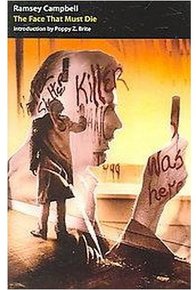
His hand splayed a stack of newspapers across the counter, spreading headlines – NEW MURDER SHOCK – and razor blades. A dozen repetitions of the identikit drawing stared up at him, an unnatural family – as though the man had infected a dozen victims until they looked like him. (p. 13)
The Face that Must Die is a serial killer novel filled with malice and social commentary. As we learn in Campbell's afterword, Horridge (the star of our rather horrific show) is in large part based on Campbell's schizophrenic, misogynistic, homophobic mother. Coming off of the novel's ending, this is not as much of a surprise as one might think. Horridge is repugnant but all too believable. His views are egregious and caustic, yet human – Horridge is humanity reflected in the most putrid of grimy, stained, gore and shit stained pools, and yet there's something about his portrayal that makes him impossible to dismiss.
What makes The Face that Must Die so convincing is that it's not a novel about larger than life characters. This is not a book about a genius cannibal doctor; this is not a tale of a criminal mastermind. Horridge is disabled and paranoid, utterly unable to tell delusion from reality. He has no plan. He is a monster, but he is never an excused monster, never a character made so extravagant or set up so elaborately that his actions lose the trappings of reality. As Poppy Z. Brite says in the introduction:
[He had] a bleak childhood but not a freakish one. Like most of his real life counterparts, Horride is simply an ineffectual creep, his disposition toward mental illness stirred by a nasty experience or two, who eventually wills himself into being dangerous; he's never explained or excused. (p. 3)
Horridge is not an extraordinary man, and he is not an ordinary man reacting to extraordinary circumstances. He is simply a man (a weak, hate-filled, arrogant man) that is broken by altogether average, albeit unfortunate, circumstances and becomes an all too average demon. The only part of Brite's summation that I'd disagree with is saying that Horride ever "wills himself to be dangerous." Horridge despises homosexuals and those around them, yes, but it's not something that he sets out to act upon. In fact, the events of the novel are almost uniformly tragic accident rather than sadistic plot.
The Face that Must Die is a comedy of errors with the humor replaced by the horror. Nothing in this novel is smooth. Horridge travels with a limp, and he's always self conscious of how he's being perceived. Early in the book, he tries to see a movie. He dislikes brushing past row after row of people in the dark, so he shows up early – but he's in the wrong theater. He's hot and prickly (p. 33) every step of the run to the proper theater, and when he gets there he's forced to shove his way past crowds of loathsome people, past: hair that twittered away, cloth that squirmed; a pool of tobacco smoke drifted sluggishly about his face. A soft drink carton crunched beneath his heel. (p. 33) And then he finds out that he hates the movie.
The power of the book comes from such scenes, the murder's merely a symptom of the main character's twisted psyche. Horridge's mind is a frightening place to spend time. His world is oppressive, and every circumstance is misconstrued. Horridge's home, Cantril Farm, was designed to confound him. The radio operator is mocking him. The people on the bus are tormenting him. The man standing beside him came here specifically to be beside him, and perhaps Horridge's being followed for a reason…
Horridge's views feel horrifically real due to their vitriol. Horridge does not have one reason to dislike gays or blacks; he's practically bursting with reasons. Horridge's internal rant (monologue feels far too tame a word) is livid and rife with contradictions, too impassioned to realize that it's making no sense. He has a thousand and one terms for what he fears. Characters are "sly as a homosexual," (p. 201) but homosexuals are also blundering. Homosexuals are perverse for fucking other men, but the women around them are depraved for what sexual deviancies they must get up to with their homosexual lovers. The homosexuals are flaunting and breaking the law, but they also control society. Even sexuality between a man and a woman is something to be feared, something to be controlled, and a society driven by its obsession with "painful orgasm" (p. 66) is obviously a depraved one, one populated by nothing but "creatures." (p. 243) It's the rage that makes the words feel real. Horridge is too vivid to be ignored, not the sane but (potentially) objectionable words of a social conservative but rather a rabid dog frothing at the mouth – he is mad, and yet his fear feels human all too human, not sympathetic in the least but loathsomely understandable all the same.
Bizarrely enough, Horridge's does not go into the novel with the intention of harming homosexuals. Quite the opposite in fact, even if his reasoning is reprehensible. A man is killing gays in Liverpool, and Horridge is convinced that the killer is a homosexual corrupting others and then killing them. Trying to do the right thing (or at least his idea of it), Horridge sets out to force the killer to confess. The man that Horridge decides must be the killer is Roy Craig, a denizen of a house on Aigburth Drive. The other lodgers there soon become a foil to Horridge, a brief taste of sanity amidst the killer's quest. Often, in scenes when Horridge and another character interact, Campbell will show us the event from both pairs of eyes in consecutive chapters. The transitions between the timelines aren't always smooth, but the contrast is the heart of the novel.
Cathy and Peter are our main non-nuts perspectives – and yet, of our three main protagonists, Cathy is the only one that is particularly normal. She's trying to save up money to buy a flat, but her husband, Peter, is reluctant and spends his money on drugs and comics. When not high, his perspective is irritable and rational, but things get interesting when he takes acid three quarters of the way through the book. Suddenly, Peter's perspective dissolves into a shifting nightmare similar to Horridge's life. Despite some interesting moments, though, Cathy and Peter are the novel's weakest link. They're fine where they are as far as being a foil for Horridge goes, but they never feel like particularly convincing characters in their own right. We often lose sight of them for dozens of pages at a time, and when we do see them, Peter earns our mild dislike while Cathy is abstractly okay but too passive to really earn our sympathy.
The Face that Must Die starts as a slow burn and, as it continues, builds to a manic sprint. Horridge is repugnant throughout, but he manages at least a thin veneer of sanity in the opening. Not so as we progress, and, as his grip on reality slips further, his actions become more drastic. The first third or so of the book consists of Horridge's attempts to unsettle Craig. This part is effective, if a bit over long, but it's nothing compared to the creepiness of when the book builds up steam. Anyone who can stop reading in the book's home stretch has super human self control, and the climax itself is excellent.
The Face that Must Die is not an enjoyable read – but it is an excellent read. This is a fascinating horror novel that takes on key issues in the way that only a horror/crime novel can. This is the first Ramsey Campbell book that I've read, but it certainly won't be the last.