Showing posts with label Crime. Show all posts

Tuesday, December 4, 2012

David Goodis - Five Noir Novels of the 1940s & 50s


The world was spinning in the wrong direction (p. 190).

Decades ago, David Goodis penned millions of words for the pulp magazines, worked on innumerable screenplays, and released a slew of classic Crime novels, including The Wounded and the Slain. Now the Library of America has released five of Goodis' novels in a single hardcover volume, and I gladly took the chance to delve deeper into the author's brutal depiction of our urban underbelly. Between the five, the characters, plots, and the presence of hope all vary considerably, but the quality of Goodis' work and the desperation of his vision are inescapable throughout.

The synopsis on the volume's back describes Dark Passage as the story of an innocent man railroaded for his wife's murder. It's accurate, but the railroading is broader than that. Goodis' characters entire lives have been railroaded. They have been condemned to live in a world they did not create, in a hopeless situation that they almost certainly cannot escape. As Goodis writes of Nathaniel Harbin in The BurglarThe world was an avalanche, taking him down (p. 362).

Goodis writes of desperation and of defiance. His men and women may find themselves in a hopeless world, but they do not surrender to it, and they will not, no matter the damage it does to them. In Street of No Return, a famous singer is beaten by two thugs. He can stop the blows any time he wants. All he has to do is give up on the woman he loves. Convinced? they ask as the blackjack falls. Convinced now? Every time, his answer is No (pp. 702-3). Finally, they hit his throat, and he loses his voice. They leave him, and he thinks that they have won. But, if Goodis is the visionary of hopeless realities, he's also a master of the hope within us, no matter the odds against it. As the singer tells himself, They didn't convince you after all (p. 749).

This kind of hope is not one borne of chances or a belief in success. It's not an indomitability of flesh but of spirit. It's not simple masochism; it's neither a wish for pain nor an ideal belief to hold actionless in the night. It's simply that Goodis' characters cannot, and will not, quit, and their determination is a matter of them and their goals, not of attainability. At the end of one novel, an innocent man, his case now hopeless, speaks to his love one last time and begins to list the nearly endless fortune they would require to ever see each other again. We'll skip the ifs, she tells him (p. 192). Reading those lines is a strange experience. Everything in the novel before them has gone wrong. The protagonist is on the run, and he can never fully escape. And yet the reader is feeling almost empowered as they turn the last page.

While hope is crucial to Goodis novels, ambition for the worldly is not. The things – the luxuries – that ambition brings are, for Goodis, almost immaterial. Though some are, it's a mistake to think every Goodis protagonist destitute. The wonderfully named Nathaniel Harbin is even covetous of material wealth, and Nightfall's James Vanning has stumbled across a massive fortune. But those fortunes prove as restraining, and as ruining, as poverty. Nathaniel knows that, ultimately, luxurious sensations never lasted for long and even while it happened was accompanied by the dismal knowledge that it would soon be over (pp. 417-8).

Goodis' characters hope for simpler things, more essential things. They crave survival, though it is far from a sure thing in these pages. They want happiness, nothing extravagant, but rather the simple and ordinary kind (p. 5), as the protagonist of Dark Passage puts it. And, perhaps the most powerfully of all, they hope for love and love's success. They know, of course, that these goals are not necessarily all compatible. Caring for another hurts them. Love hurts their chances. It is, without a doubt, a problem (p. 596). Often, it threatens to doom them or actually does. Nonetheless, it may be the only thing that makes all the pain worthwhile. It may be the only way to truly escape, or maybe even to transcend, the misery of the world. Speaking of Street of No Return's singer and the love he was beaten for, Goodis writes: In the bed with her it was dark but somehow blazing like the core of a shooting star. It was going 'way out past all space and all time (p. 689).

All of this is beautifully forced upon the reader by some of the strongest prose I've ever read. Goodis' writing is a complex art crafted from the simplest of building blocks. On the sentence level, Goodis is fully capable of fantastic imagery, such as: In the ash tray near the bed, the stubs became a family that grew through the night (p. 298). But those sentences are easy reads, graspable things, and, above all, perfectly in character. Every sentence is the very embodiment of the speaker or viewpoint's soul and mood and thought. It's likely this gift with plain but evocative prose that grants Goodis his gift for dialogue. His characters speak with their own voices, and he has the rare gift of being able to let them converse on any topic that enters their mind while still showing so much of their character so as to never feel as if he is going off topic.

Things don't stop at the sentence level, though, for, at the novels' key moments, these sentences flow into one another, thoughts flowing into thoughts, until we end with passages of nearly free association, of a stream of consciousness made of the simplest parts that never loses their easy heart of understandability. In this way, Goodis blends individually clear images with one another to create wholly new modes and tones, and his protagonists wrestle with themselves and their own thought as the text follows along with their argument, an internal debate that reads with all the force of our own. A relatively brief example, in which the protagonist of Dark Passage thinks of the constraints he was under even before the crime:

He was going back and taking chunks out of his life and holding them up to examine them. The young and bright yellow days in the hot sun of Maricopa, always bright yellow in every season. The wide and white roads going north from Arizona. The grey and violet of San Francisco. The grey and the heat of the stock room, and the days and nights of nothing, the years of nothing. And the cage in the investment security house, and the stiff white collars of the executives, stiff and newly white every day, and their faces every day, and their voices every day. And the paper, the plain white paper, the pink paper, the pale-green paper, the paper ruled violet and green and black in small ledgers and large ledgers and immense ledgers. And the faces (pp. 102-3).

In terms of the novels themselves, the first two are by far the closest of any of the pieces here. Both Dark Passage and Nightfall star men wrongly pursued by the full weight of the law and desperate to clear their names. Furthermore, both possess puzzle style crimes that the protagonists must solve if they are to have any hope or proving their innocence. The mystery in the latter relies to a large extent on one very nonsensical act that makes guessing it before the reveal just about impossible, so, in that regard, the former is the stronger. Still, Nightfall can boast the bizarre but fascinating relationship between its protagonist and the detective that pursues him and, gradually, begins to believe in his innocence and to strive as hard as he to clear his name.

Like those two, The Burglar has a suspenseful plot that has its characters struggling to escape the law and keep their lives. But, and rather unlike them, its heroes are most certainly not innocent. Nathaniel Harbin and his closest friends are professional burglars. But while they might be nominally outside of society's rules, they are not out of its heart: Every animal, including the human being, is a criminal, and every move in life is a part of the vast process of crime. What law, Gerald would ask, could control the need to take food and put it in the stomach? No law, Gerald would say, could erase the practice of taking. According to Gerald, he basic and primary moves in life amounted to nothing more than this business of taking, to take it and get away with it (p. 416).

Nathaniel and his fellows were born at the bottom, were left with nothing. They refused to stay there, and they have fought their way to a living. But that living is not secure, and, now, they have come up against a foe that may prove as unprincipled and as determined as they are. Despite its solid illegality, The Burglar is not an amoral novel. Though a crook, Nathaniel has not left honor. Behind as his mentor once said: What mattered, what mattered high up there by itself all alone […] was whether things are honorable (p. 418). As it progresses, The Burglar becomes a tale of honor tested and also of different and impossible kinds of love. I won't spoil the finish's particulars, but I will say that The Burglar has one of the most crushing endings of any book I've read.

Though still certainly a Goodis work, The Moon in the Gutter is a very different beast from its fellows here. Like The Blonde on the Street Corner (not included here), it is a largely plotless exploration of society's lowest rungs. Kerrigan is very aware that he and all the other denizens of Vernon Street are riding through life on a fourth-class ticket (p. 496), but he has nonetheless fallen in love with an uptown woman who loves him back. Furthermore, he must face his sister's pointless and ugly death mere months before. The novel's climax comes as Kerrigan looks out a window, over the houses and denizens of Vernon Street, and suffers the following revelation:

And no matter where the weaker ones were hiding, they'd never get away from the Vernon moon. It had them trapped. It had them doomed. Sooner or later they'd be mauled and battered and crushed. They'd learn the hard way that Vernon Street was no place or delicate bodies or timid souls. They were prey, that was all, they were destined for the maw of the ever hungry eater, the Vernor gutter.

He stared out at the moonlit street. Without sound he said, You did it to [my sister]. You (p. 615).

Though inevitable, the revelation is not altogether satisfying. When Kerrigan decides that he and his love can never be together, it's not a surprising decision, but the reader has still never seen a single scene of their failing to be so, only presentiments that it will happen. It's painful to see one of Goodis' narrators give up his struggle and bow his head to fate, but, while The Moon in the Gutter is a powerful read, it's the least successful one in this collection.

Street of No Return is a more eventful than the preceding read, but its strongpoint is not its plot, which is held together by a bevy of coincidences and a revelation that is not as hard to piece together as the characters might have you believe. That is not, however, to say that it is a weak novel, for here Goodis excels with his atmospheric depictions of Philadelphia and through his portrayal of his protagonist, the once-famous singer that I discussed long ago in the review's beginning and that singer's slow motion suicide, his life lived after his loss as Going down. One step at a time (p. 708). Furthermore, Goodis quickly and sympathetically establishes his police characters and those of the other souls the novel's protagonist meets in his flight. The book's climax is a triumph, and a clearing of the main character's name, but it is not a final triumph, and, after what could in many novels be a Happy Ever After, Goodis shows his hero return without a word to the near-hopeless brutality of the life he's left.

In this collection, the Library of America was kind enough to give us five brutally powerful novels, each resplendent with not only overwhelming darkness but also strength and hope. David Goodis is a master of Noir, and this is the largest, and likely best, collection of his work you'll find anywhere.

Tuesday, August 14, 2012

Raymond Chandler - The Long Goodbye

The Long Goodbye is the sixth of Raymond Chandler's seven classic novels starring Philip Marlowe. In the broad outlines of its plot and genre, it fits neatly into the progression established by the rest, but differences soon become apparent. This is the longest of Chandler's novels by far, and it's also the slowest in pace. Here, Chandler focuses more than ever before on not only Marlowe's voice, but his observations about society, his sketches of characters and flaws, on not only combating the corrupt world but understanding it and coming to terms with it.

Of course, The Long Goodbye is still a crime novel. It's practically the calling card of noir, the very pinnacle of the genre. And yet the actual crime is never the point. Chandler writes about crime because Marlowe's (our) life is made of corruption and pain, but the mystery itself is just the lense with which we see the brutal world. Chandler's Marlowe is worlds away from Doyle's Holmes or Poe's Dupin. These are not puzzles. The goal is not some abstract solution. There are lives at stake here; we have left the realms of impersonal deductions and clues far behind. In the absence of that intellectual game, we're just left with the violence and the pain, but, in marked contrasts to so many that had already come and that would come later, Chandler does not revel in the violence. This is not a novel about odds or gunplay, about fistfights and triumphs, though it does have all of those things. Believe me, pal, there is nothing elevating or dramatic about it, one character writes, with the "it" in question being death, or maybe suicide, crime, struggle, flight, sacrifice, or even maybe heroism. It is just plain nasty and sordid and gray and grim. (p. 84)

The Long Goodbye is a novel about why we act and why we don't. About heroism in the modern world and that world itself. The way the competition is nowadays a guy has to save his strength to protect hisself in the clinche, (p. 6) a character says early in the novel. Smart men know to stay out of people's troubles. (p. 280) Nobody cares, and nobody can afford to care. Those that do seem to enforce the law do it for all the wrong reasons, for power, money, or pride. They know that the law "isn't justice" (p. 56) and that they can "always find a way to do what they want." (p. 55)

Philip Marlowe is an exception. He acts for an idea of justice that's not what's found in the law books or on the streets, not encased in popular opinion or built on misery. As we see time and time again, Marlowe will never back down from what he thinks is doing the right thing. But while toughness might be enough to keep you alive, it's not enough to let you prosper. Marlowe can never win, and he is all too aware of that fact. As he learns so many times, there's "no percentage" in being a hero (p. 236), and, if Marlowe manages to survive, he does it by the skin of his teeth and with nothing at all to show for it but justice.

Crucially, The Long Goodbye is not the story of a crusade. This is not a book of the White Knight Marlowe against a world of immoral Black. No, the Los Angeles of the novel is one where culpability is only matched by inevitability and where all is painted shades of struggling gray. The early realization is that crime isn't responsible for all this alone; it's power that's torn us so asunder, and, as Marlowe says, the "only difference" between business and crime is that, "for business you gotta have capital." (p. 188) The world is anything but equal, and the average man seems powerless against the rich giants all about him. He is tired and sacred, we're told, and a tired, scared man can't afford ideals. (p. 234) But the ultimate realization, the novel's killing blow, is that Crime isn't a disease. It's not something that Marlowe can defeat, no matter how hard he hits or how clever he is. No, crime is a symptom. Cops are like a doctor that gives you aspirin for a brain tumor, except that the cop would rather cure it with a blackjack. We're a big rough rich wild people and crime is the price we pay for it, and organized crime is the price we pay for organization. We'll have it with us for a long time. Organized crime is just the dirty side of the sharp dollar. (p. 352)

Every step of the way, Chandler writes with a splatter-painting style of figurative language, a barrage of similes that range from hilarious to profound, and all of it's charging forward with the strength of some of the most muscular, powerfully direct prose imaginable. Brute declarative statements meet metaphors, here, and it's all aided by one of the most prevalent and cutting wits I've had the pleasure of reading, every page peppered with delightful phrases like: he looked at me like a horse looking over a fence (p. 250) and they put as much muscular activity into a telephone conversation as I would put into carrying a fat man up four flights of stairs. (p. 88) More than that, though, Marlowe's observations cut beyond the realm of double-dealings and rich adulterers and strike into the timeless, both in the already discussed area of morality and in a thousand small facets of life, with the intervening decades between us and him just serving to cement his claims: There is something compulsive about a telephone, he says. The gadget-ridden man of our age loves it. Loathes it, and is afraid of it. But he always treats it with respect, even when he is drunk. The telephone is a fetish. (p. 200) And, of course, you know you can trust the judgments of a man who swears he will never again use an electronic razor. (p. 153)

Despite all that, and despite its first person narration, and despite the fact that Marlowe is one of the most characteristic and opinionated narrators I can think of, the detective's actual thoughts, plans, and emotions are kept far away from us. In fact, the combination of Marlowe's perceptive eye and recalcitrant mind have the odd effect of giving us far more of just about every other character's emotional state than we get of the narrator's. As a result, it can be hard to tell just who Marlowe is. We can primarily know him by what he is not, which is to say by the depravities and corruptions that he turns away from. But exactly why Marlowe is the way that he is is difficult to say. Why is he a hero in this world where heroism is impossible?

On a more grounded level, this also means that The Long Goodbye can come to seem aimless at times. Marlowe himself moves with purpose in everything he does, but, as we're never allowed to see it, it's easy to lose track of the narrative and get lost in the steps along the way. More importantly, the friendship between Terry Lennox and Marlowe, established early in the novel and crucial throughout, is always a distant thing. Some degree of ambiguity in it is understandable, of course, but – save for one powerful exception – that relationship that is such a driving force for the narrator is never felt at all by the reader.

That distance and Marlowe's observations, the latter the novel's greatest strength by far, serve to hamstring the part of it that is actually a crime novel. Throughout, the mystery is buried under Marlowe's wit, attitude, and judgments. While that makes the novel infinitely stronger than it would've been as just another plot boiler, it does leave the reader focusing on things other than the clues and not particularly invested in the ultimate identity of the killer. Up until the novel's three hundredth page (or so), this really isn't such a problem. The mystery's not exceptional, but in a book this strong, it doesn't need to be, and it's adequate.  Unfortunately, the last sixty pages, all taking place after the seeming resolution, are far more plot focused than anything that came before – and also far less successful. Chandler somehow manages to strike a regrettable balance between meandering bloat and a feeling that everything we see is rushed. Scene after scene feels like it could be the novel's last but isn't, the plot still stumbling through another (frankly unnecessary) turn that would've needed a great deal more space to make us really understand it, let alone care about it.

The brilliance of The Long Goodbye is a direct result of its most deadly failings. Judged by the crime genre's standard strictures of plot and climax, this novel is a failure. Yet that does little to diminish its overall power. The Long Goodbye is, despite and also because of all its faults, an insightful and excellently written that deserves its classic status.

Tuesday, June 19, 2012

Larry D. Sweazy - The Rattlesnake Season

I am not an expert on the Western genre. In fact, this is the second Western I've read in my life, and the first was read so long ago that I couldn't quite understand what all the prostitutes were up to. My interest in the genre was sparked, though, by a conversation with someone who likely could be called an expert in it, who compared the Western to Crime fiction and argued that Dashiell Hammett's Red Harvest could be said to be an archetypical Western. In that conversation, The Rattlesnake Season earned mention, and its cover does boast that it "Ris[es] to the level of a classic." Having read the novel, I can confirm that the fellow was certainly onto something; the Western does seem a brother to historical Crime fiction. Alas, The Rattlesnake Season is not good Crime fiction.

Reeling from the loss of his wife and daughters to disease, former soldier and determined lawman Josiah Wolfe briefly leaves behind his young son to take his place in the newly reascended Texas Rangers. His first assignment with them brings him right back to the heart of his past. Once, Josiah and Charlie Langdon were not only brothers in arms but friends, and, after the war, Josiah trusted Langdon enough to deputize him before Charlie's fall into lawlessness. Now it's up to Josiah, Captain Hiram Fikes, and a group of other Rangers to bring Langdon to justice against the best efforts of his gang. Needless to say, all hell breaks loose, and Langdon is soon on the run with the rest struggling to not only catch him but also to deal with the traitor in their midst.

The relationship between Josiah and Langdon, however, is problematic – by which I mean that it's nonexistent. Though we're told that Josiah knows Langdon better than anyone, the two never meaningfully converse. Worse, in his desire to demonize Langdon and raise the stakes, Sweazy falls back on memories of the Civil War, in which he paints Langdon as a psychopath, someone who enjoys slaughter and the killing of children, someone who loves to "torture" his victims with "slow cutting," a method of gaining information through the inflicting of "shallow slits in the skin from a sharp knife" (p. 275). We're told that "Josiah was convinced that Charlie Langdon was born with a deep and abiding hate in the pit of his stomach and had never known a moment of love or tenderness." (p. 52) So why, then, did Josiah not only consider Langdon a friend but deputize him? How can he act surprised, now, by Langdon's viciousness when he explicitly tells us at great length that he was aware of that viciousness from the start?

An easy solution to all this would have been simply to remove the element of their prior friendship, which never plays a role in their interaction when they're together. But then, of course, we couldn't have our utterly nonsensical climax, in which Langdon – having already escaped his pursuers – doubles back to take Josiah's son hostage. There is absolutely no reason for him to do this. None.  At all. It would be like if a criminal, after escaping the FBI and crossing the border, decided he had nothing better to do than go back, take the Bureau's chief prisoner, and hole himself up in a building to be shot by a sniper. Then again, Sweazy doesn't even give us that last part, as it's a rattlesnake that brings Langdon down, rather than something boring like, say, any action on the part of the main character we just spent the book following.

Sweazy is at his best when invoking setting; he is fully capable of building hot, crowded streets to life and filling them with voices, smells, and characters. Unfortunately, his skills at setting often come at the expensive of narrative. Certain details – like how Rangers don't wear badges – are repeated ad nauseum until the reader's sick beyond belief of hearing them and groans aloud at the next mention of how Josiah wants the new model Winchester or how he leaves one chamber in his gun empty for the gun's health. The worst of all of these repetitions comes after a cliff hanger. After a chapter ending with Josiah finding his own pistol pointed in his face, Sweazy spends a paragraph short of two interminable pages info dumping the gun's entire history. Then there's Sweazy's bizarre tendency to explain clichés as if we had all never heard of figurative language before: Scrap Elliot looked like he had just been scolded by his father – even though Feders wasn't old enough for such a thing to be considered, his being Scrap's father, that is. (p. 98) It's a good thing he pointed it out; as someone capable of reading a three hundred page novel, I never would have known that the word "like" implied a break from the literal.

As a novel starring the Texas Rangers, it's not surprising that The Rattlesnake Season's main theme is justice. What is surprising, though, it how ineptly and contradictorily that theme is explored. Josiah is one of the least self aware characters I've ever read about, and his ideas of justice seem to be nothing but a high minded excuse to do as he pleases and flip flop faster than can be believed. Towards the top of page 158, he says "McClure's guilt or innocence was not for him [Josiah] to decide." (p. 158) Less than five paragraphs later, towards the bottom of the page, we get:  "If there was the slightest chance that Vi McClure was innocent, then it was Josiah's duty to find out, his duty to bring the truth to the surface." (pp. 158-9)

But maybe there is something in the middle of all these seeming contradictions. Justice isn't easy, it's a tough concept. Let's try to piece together what Josiah does and says and see if anything coherent emerges. Early on, Josiah wonders how a person could come to disregard life so much that he would try to kill a man he did not know, for a reason that was not his own, as if it were a job, just another task to be fulfilled. (p. 31) In the course of the novel, Josiah does kill, and we know that he killed in the war, making that a rather strange thought to have. Maybe you could argue that, for Josiah, it was personal, though. After all, he was fighting to avenge his captain, Hiram Fikes. Only… isn't that what the enemy's doing, fighting for their own captain, Charlie Langdon?

Okay, so personal loyalty alone can't make justice. Maybe it's a question of self preservation? In the early parts of the novel, that seems to make sense. Josiah fights back when attacked, but he says that, if he and his fellow rangers watch a helpless criminal die, they would be "no better men than he is." (p. 30) Alas, this explanation of justice comes to a screeching halt when Josiah squares off against the traitor towards the novel's end. Now, the traitor did shoot first, so Josiah's first shot to the fellow's stomach makes sense. Maybe even his shot to the chest, "just under the heart." But, after that one, as his foe "bounced on the muddy ground, a combination of convulsions caused by being shot and his body finishing the motion of shooting at Josiah," Josiah still fires again, a coup de grace, a blow to just under the fellow's "right eye." (p. 283) Something makes me think the fellow wasn't getting up after the bouncing and convulsing stage, so, if preservation is our idea of justice, then Josiah just violated it.

Then, of course, there's the most obvious kind of justice of all, especially to a lawman. Maybe Josiah considers justice a matter of following the law? Nope, as it turns out. To return to one of the earlier quotations, and to go just before it, Josiah is standing over a badly wounded outlaw, and he says that: "Justice is not ours to dole out, my friend." (p. 30) So simply being an outlaw isn't a death sentence, but we know that Josiah has no compunctions about killing when justice calls for it, and we also know that justice does not come from self preservation.

As it happens, law and justice are again held apart in the quotation that finally gives us our answer: Even if Vi McClure did turn out to be an outlaw, Josiah didn't want the world passing judgment before justice got its own chance to make the truth known. (p. 123) So, survival, personal loyalty, and law alone are not enough to make up justice. What is? Well, in the above quote, you might notice that justice is strangely active. It's coming on its own, independent of the character's actions, to make the truth known. In fact, in The Rattlesnake Season, justice is none other than plot, the author's hand reaching down from above to show the truth, to remove all incriminating doubts, to make sure that the traitor monologues his guilt just before we must face the hard job of shooting him.

The Rattlesnake Season is thematically incoherent, unexciting in its action, and bewildering in its plot twists. It's not offensively bad, but it's not good, and it lacks a single true strength to balance out its flaws. If this is, truly, a "classic," as the aforementioned cover quote would have us believe, I fear for the Western genre.

Friday, September 2, 2011

Dashiell Hammett - The Continental Op

Then I turned on all the lights in the room, lighted a cigarette (we all like to pose a little now and then), and sat down on the bed to await my capture. (p. 111)

Though Sam Spade, famous for his starring role in the Maltese Falcon, might have a higher profile, it's the Continental Op that narrated the lion's share of Dashiell Hammett's fiction, including Red Harvest, The Dain Curse, and the bulk of the man's short fiction. Containing seven stories written between 1924 and 1930, the The Continental Op collection from Black Lizard is filled with tales that perfectly show one of the genre's best on his home turf.

Mystery – the hodgepodge bookstore section for mysteries, crime, and thrillers, that is – is at its heart a rational genre. To boil the genre down to a single glib sentence, the genre is the solving of puzzles. At the opening of the story, the detective, and the reader, is confronted with a situation that makes no sense. Then, like the Scooby gang demasking another supernatural ghost to find a middle aged man, the detective makes sense of the clues and replaces impossibility with a logical procession of events. Any in genre story by Poe, Doyle, or any of their authorial descendants, begins with a series of incomprehensible clues and ends with motive, miscreant, and method all neatly tied up and – if the author's good at what they do – no disappointing coincidences or absurdities remaining.

Dashiell Hammett's stories do not function like that at all, though the Continental Op does indeed go through his own process of investigation. Hammett's aim is not the puzzle but rather the implications of the puzzle, and his stories are not riddles that can be satisfactorily deduced by even the most skilled reader-sleuth hybrid. Hammett's mysteries are mysteries of people and society, not of circumstance, and the Op learns far more by sheer force of will and his own dogged determination than he does from any brilliant analysis of clues.

This is perhaps best exemplified by the collection's first story, The Tenth Clew (available for free here). The Op and the local police find themselves confronted with a murder and a surfeit of clues – or, as I suppose I must, clews. Instead of following the trail to the bloody end, however, the Op disregards all of them and focuses on the man behind them, hunting the personality rather than the evidence. For Hammett, the deduction is, at best, a sideshow, and not only is the reader almost never given all the pieces before the reveal, they're also almost never even shown the Op's process of discovery.

But those are but surface differences. No, the true difference between the genre of mysteries and the writings of Dashiell Hammett is what Steven Marcus discusses in his fantastic introduction. As I said about, mystery is inherently a rational genre. But Hammett is inherently not a rational writer. Like all detectives, the Op reveals the lies of common sense and criminals for what they are, but the truth he uncovers is just as illogical as his foes' deception. Hammett's stories are all but made out of defied expectations, and his revelations are filled with people who are not who they claim to be, crimes committed for reasons incomprehensible, random bursts of violence, and coincidences and hapless fate so twisted as to be delicious. As Marcus says:

Yet what happens in Hammett is that what is revealed as "reality" is a still further fiction-making activity – in the first place in the Op's, and behind that yet another, the consciousness present in many of the Op stories and all the novels that Dashiell Hammett, the writer, is continually doing the same thing as the Op and all the other characters in the fiction he is creating. That is to say, he is making a fiction (in writing) in the real world; and this fiction, like the real world itself, is coherent but not necessarily rational. What one both begins and ends with, then, is a story, a narrative, a coherent yet questionable account of the world. (p. XXI)

For Hammett, the world as we see it is a very flimsy thing, a construction easily sidestepped by both the intending and the oblivious. Identity, for him, is a passing thing, a garb easily donned and discarded. As one captured villain says of their slipping through the cracks: Then I took an apartment on Ashubry Avenue under [an assumed name], and I was an altogether different person. (p. 169, The Girl with the Silver Eyes) (name removed for the sake of spoilers)

Perhaps the Continental Op is a bulwark of justice in such an immoral world, but the Op himself doesn't seem so much moral as amoral, a nameless everyman in appearance and intellect notable only for his force of will. The Continental Op does not share the ambiguity that adorns Sam Spade throughout the Maltese Falcon, but he is also as far as cry from Chandler's Philip Marlowe as he is from Sherlock Holmes. Like in Red Harvest, the Op doesn't care about methods so long as he gets the job done, and his idea of the job is often a far cry from that of his employer's.

In The Golden Horseshoe, we see that the Op's goals are not that of the law, but rather of justice. Providing he can see justice done, the Op doesn't care what story he has to feed the law. In The Main Death, the Op goes one step further. In case too convoluted to ever be won at trial, he takes the law into his own hands, regains the victim's property with force, and buries the facts under a happy outcome. In The Farewell Murders, he reveals that his idea of justice doesn't even extend to seeing the good prosper – he just needs to see the wicked suffer. The Op responds to the continued misfortune and even tragedy of his employer without even a sympathetic word, and he weathers years and false ends all so that, at the end, he can see the guilty hanged.

The Op's justice is a harsh one, and, to him, the guilty deserve no rights at all. When he tells the story of a former cop, Duran, it's clear where his sympathies lie: He used to be captain of detectives in one of the larger Middle Western cities. Once he tried too hard to get a confession out of a safe-ripper, and killed him. The newspapers didn't like Duran. They used that accident to howl him out of his job. (p. 190) I don't believe it's a coincidence that five of the seven stories ends with the following emotionless sentiment: They hanged him. (p. 319)

We've established by now that the thrill of a Hammett story is not the solving of the mystery, but we haven't yet looked into where precisely the thrill is to be found. The answer comes from the prose and the hardboiled, unsentimental, and unflinching interaction of the Op and the world around him. Hammett's writing is clear, terse, and able to both convey volumes of style while simultaneously revealing almost no emotion at all. In the midst of this, the Op often further reinforces his detachment with instances of wit so dry and caustic they're liable to start forest fires: The face she made at me was probably meant for a smile. Whatever it was, it beat me. I was afraid she'd do it again, so I surrendered. (p. 57)

Among other things, Hammett has a gift for pegging characters in only a few lines and in picking out the one detail that makes them memorable. Alas, while he refrains from over indulging in pointless back stories, he loves to drown the telling and significant details he's created in oceans of white noise and minutia: Age about 30; height about five feet ten; slender, weight about 140; medium complexion; brown hair, suit, and shoes and a gray overcoat. (p. 252) I suppose that, if the infamous police report style of description is to ever find a home it would be here, in a novel about a private detective, but that doesn’t change the fact that such a storm of details leaves the reader with far less, not far more, of a picture than they would otherwise have had. And lest you think that example unique, here's another from the same page: [he was] about five eight inches tall, would weight about a hundred and seventy pounds, had brown hair and eyes, a dark complexion, a flat, broad face with his cheekbones, and wore a blue suit, gray hat, tan overcoat, black shoes, and a pear-shaped pearl tie-pin. (p. 252)

The newest of these stories is eight decades old, and it's true that their levels of gore and profanity feel tame to a modern audience. Their core, however, feels anything but. Hammett's grasp of atmosphere and pace is excellent here, and his ability to build tension is unmatched. After a classic Hammett moment of false perceptions, The House on Turk Street becomes a deadly game of cat and mouse in an unlit house. Other stories, too, are prone to sudden escalations that lead to scenes of violence that are either so brief as to be downright blunt as well as merciless or long, drawn out passages of waiting for the flash of gunfire to give away the enemy. Both styles of action work incredibly well, and each is stronger for the downbeat forced calm that surrounds it.

The Continental Op is a collection of stories that will make your pulse pound. It's also a collection of stories that contain surprising amounts of depth and even revelation. This is an essential read for anyone interested in Dashiell Hammett, noir, mystery in general, or even just good fiction.

Tuesday, May 24, 2011

Dashiell Hammett - Red Harvest

I first heard Personville called Poisonville by a red-haired mucker named Hickey Dewey in the Big Ship in Butte. He also called his shirt a shroit. I didn't think anything of what he'd done to the city's name. later I heard men who could manage their r's give it the same pronunciation. I still didn't see anything in it but the  meaningless sort of humor that used to make richardsnary the thieves' word for dictionary. A few years later I went to Personville and learned better. (p. 3)


Dashiell Hammett's ground breaking Red Harvest is the first book by one of the grandmasters of Noir, and it might surprise you to learn that the iconic opening paragraph quoted above is probably the book's wordiest section. Hammett writes chaos and crime with all surplus and emotion excised, and the power that slips in through the spaces is awe inspiring. The book may have come out in 1929, but its every sentence hits with incredible strength today, and the picture it paints is no less relevant and no less terrifying than it ever was.

Our opening is a rather standard crime beginning: our detective – the unnamed Continental Op – goes to the home of the man who hired him. The man's not home, so the wife greets out protagonist, but she's called out. When she returns, her lift slipper is dark and damp with something that could be blood. (p. 8) Unfazed, she tells the Continental Op that her husband "won't be home tonight." (p. 8) Within only a few pages, that initial murder is almost lost in an explosion of corruption and violence. Personville is not plagued by a single problem but is, rather, an entire town of avarice, a cesspit incapable of viewing order as anything but oppression from a new source.

The Continental Op strides into this urban hell and burns it to the ground. Well, okay, no – the town's still standing at the end of the book. But you'd be forgiven for doubting that at more than a few of the book's apocalyptic gunfights and revelations. Much of noir seems to focus on understatement and small scale conflict. David Goodis's The Wounded and the Slain, for instance, shows the inherent corruption and malleability of humanity through a single nobody's accidental misadventure in the backstreets of Jamaica, an episode unlikely to so much as make the local paper. Hammett approaches the same thematic stomping ground from the opposite direction. Red Harvest is larger than life and archetypical, a tale of amoral justice writ in blood across the streets of a city boasting "some forty thousand inhabitants." (p. 70)

In terms of stark brutality, Red Harvest is on par with modern classics like Cormac McCarthy's Blood Meridian. Reading the book, it's not hard to see how French existentialists and others view the novel as an allegory for order first coming to mankind. Such biblical aspirations, amusingly enough, fit perfectly with Hammett's terseness, and comparisons abound: the Continental Op is bringing law to the citizens of Personville at the behest of the far off but all powerful "Old Man" while the citizens desperately cling to their decadent lawlessness.

That being said, such black and white readings have trouble in the face of the humanity and ambiguity of Hammett's characters. Though Hammett's narration never leaves the Continental Op's perspective, we're never allowed inside his head, and the characters actions are as much a mystery to us as they are to the townspeople until he chooses to explain himself. The benefits of this – competently executed – on a mechanical level are obvious, allowing the Continental Op to surprise the reader as much as his adversaries with his deductions and actions. On a thematic level, however, things get even more interesting.

Corruption in Personville is not something that can be fought with law or morals. As the Continental Op says to a fellow operative: Anybody that brings any ethics to Poisonville is going to get them all rusty (p. 117). But death becomes seductive, and the Continental Op soon seems to pursue chaos for its own sake, preferring the grace of a bullet to the difficulties of the courtroom. The crux of Personville's corruption of him, however, comes near the end of the book.

[Note: skip to the next paragraph to aovid SPOILERS] After a series of traumatizing and horrific dreams, the Continental Op finds himself abed with a murdered woman, and it's his hand upon the ice pick. Did he kill her? Even the Continental Op cannot answer that question, but he's forced to proceed under the assumption – one that the world around him wholly believes – that he was, in fact, the murderer. In the end, it turns out that one of the book's many villains was the true culprit, but the message is still clear. We're all skirting corruption; we've all got our hands on the handle of the ice pick. And the only thing that decides who shoves it in deep is mere happenstance.

Red Harvest functions as a laconic fever dream. Short chapters and shorter sentences, an absence of description and inner monologues, and characters forced to survive day after day on fortifying alcohol instead of sleep all contribute to a book and a life impossible to escape. Amidst all the grimness, the Continental Op's sense of humor is so bald faced you might not notice the joke until a second glance. As he says to one foe: Be still while I get up or I'll make an opening in your head for brains to leak in. (p. 97)

Detective fiction is an inherently goal oriented genre, and Hammett makes use of small story arcs to build his big picture. Having the Continental Op battle all of Personville at once would be impossible from the perspective of the reader's comprehension as well as narrative coherence, so Hammett breaks the Continental Op's war down into increasingly large scale chunks as the operative goes after one or two of the city's villains at a time amidst a network of shifting alliances.

Hammett's tautness can, at times, cause problems. The central characters are never deep in the traditional sense, but they each grow fascinating as the novel progresses. Those in the periphery, however, aren't given this chance, which leaves Lew Yard and Pete the Finn, among others, as nothing but names and vague outlines. There is also the occasional passage where the prose misses vividness and instead falls into uninvolving summary. At one point, for instance, a climactic fight scene is described as:

Noise and fire came out under a window sill.

The gray mustached detective fell down, hiding the axe under his corpse.

The rest of us ran away. (p. 121)

Red Harvest is a Crime classic that roars from the first page to the last. I started the book in an idle five minutes and finished it in the early morning hours of the next day – horrified, disgusted, and too charged with energy to sleep for hours yet. If you're a Noir devotee or have yet to read so much as a page of the genre, Red Harvest is an absolutely essential novel.

Tuesday, March 29, 2011

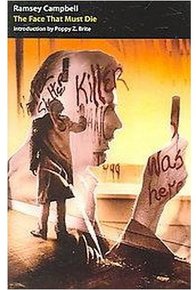
Ramsey Campbell - The Face that Must Die

His hand splayed a stack of newspapers across the counter, spreading headlines – NEW MURDER SHOCK – and razor blades. A dozen repetitions of the identikit drawing stared up at him, an unnatural family – as though the man had infected a dozen victims until they looked like him. (p. 13)

The Face that Must Die is a serial killer novel filled with malice and social commentary. As we learn in Campbell's afterword, Horridge (the star of our rather horrific show) is in large part based on Campbell's schizophrenic, misogynistic, homophobic mother. Coming off of the novel's ending, this is not as much of a surprise as one might think. Horridge is repugnant but all too believable. His views are egregious and caustic, yet human – Horridge is humanity reflected in the most putrid of grimy, stained, gore and shit stained pools, and yet there's something about his portrayal that makes him impossible to dismiss.

What makes The Face that Must Die so convincing is that it's not a novel about larger than life characters. This is not a book about a genius cannibal doctor; this is not a tale of a criminal mastermind. Horridge is disabled and paranoid, utterly unable to tell delusion from reality. He has no plan. He is a monster, but he is never an excused monster, never a character made so extravagant or set up so elaborately that his actions lose the trappings of reality. As Poppy Z. Brite says in the introduction:

[He had] a bleak childhood but not a freakish one. Like most of his real life counterparts, Horride is simply an ineffectual creep, his disposition toward mental illness stirred by a nasty experience or two, who eventually wills himself into being dangerous; he's never explained or excused. (p. 3)

Horridge is not an extraordinary man, and he is not an ordinary man reacting to extraordinary circumstances. He is simply a man (a weak, hate-filled, arrogant man) that is broken by altogether average, albeit unfortunate, circumstances and becomes an all too average demon. The only part of Brite's summation that I'd disagree with is saying that Horride ever "wills himself to be dangerous." Horridge despises homosexuals and those around them, yes, but it's not something that he sets out to act upon. In fact, the events of the novel are almost uniformly tragic accident rather than sadistic plot.

The Face that Must Die is a comedy of errors with the humor replaced by the horror. Nothing in this novel is smooth. Horridge travels with a limp, and he's always self conscious of how he's being perceived. Early in the book, he tries to see a movie. He dislikes brushing past row after row of people in the dark, so he shows up early – but he's in the wrong theater. He's hot and prickly (p. 33) every step of the run to the proper theater, and when he gets there he's forced to shove his way past crowds of loathsome people, past: hair that twittered away, cloth that squirmed; a pool of tobacco smoke drifted sluggishly about his face. A soft drink carton crunched beneath his heel. (p. 33) And then he finds out that he hates the movie.

The power of the book comes from such scenes, the murder's merely a symptom of the main character's twisted psyche. Horridge's mind is a frightening place to spend time. His world is oppressive, and every circumstance is misconstrued.  Horridge's home, Cantril Farm, was designed to confound him. The radio operator is mocking him. The people on the bus are tormenting him. The man standing beside him came here specifically to be beside him, and perhaps Horridge's being followed for a reason…

Horridge's views feel horrifically real due to their vitriol. Horridge does not have one reason to dislike gays or blacks; he's practically bursting with reasons. Horridge's internal rant (monologue feels far too tame a word) is livid and rife with contradictions, too impassioned to realize that it's making no sense. He has a thousand and one terms for what he fears. Characters are "sly as a homosexual," (p. 201) but homosexuals are also blundering. Homosexuals are perverse for fucking other men, but the women around them are depraved for what sexual deviancies they must get up to with their homosexual lovers. The homosexuals are flaunting and breaking the law, but they also control society. Even sexuality between a man and a woman is something to be feared, something to be controlled, and a society driven by its obsession with "painful orgasm" (p. 66) is obviously a depraved one, one populated by nothing but "creatures." (p. 243) It's the rage that makes the words feel real. Horridge is too vivid to be ignored, not the sane but (potentially) objectionable words of a social conservative but rather a rabid dog frothing at the mouth – he is mad, and yet his fear feels human all too human, not sympathetic in the least but loathsomely understandable all the same.

Bizarrely enough, Horridge's does not go into the novel with the intention of harming homosexuals. Quite the opposite in fact, even if his reasoning is reprehensible. A man is killing gays in Liverpool, and Horridge is convinced that the killer is a homosexual corrupting others and then killing them. Trying to do the right thing (or at least his idea of it), Horridge sets out to force the killer to confess. The man that Horridge decides must be the killer is Roy Craig, a denizen of a house on Aigburth Drive. The other lodgers there soon become a foil to Horridge, a brief taste of sanity amidst the killer's quest. Often, in scenes when Horridge and another character interact, Campbell will show us the event from both pairs of eyes in consecutive chapters. The transitions between the timelines aren't always smooth, but the contrast is the heart of the novel.

Cathy and Peter are our main non-nuts perspectives – and yet, of our three main protagonists, Cathy is the only one that is particularly normal. She's trying to save up money to buy a flat, but her husband, Peter, is reluctant and spends his money on drugs and comics. When not high, his perspective is irritable and rational, but things get interesting when he takes acid three quarters of the way through the book. Suddenly, Peter's perspective dissolves into a shifting nightmare similar to Horridge's life. Despite some interesting moments, though, Cathy and Peter are the novel's weakest link. They're fine where they are as far as being a foil for Horridge goes, but they never feel like particularly convincing characters in their own right. We often lose sight of them for dozens of pages at a time, and when we do see them, Peter earns our mild dislike while Cathy is abstractly okay but too passive to really earn our sympathy.

The Face that Must Die starts as a slow burn and, as it continues, builds to a manic sprint. Horridge is repugnant throughout, but he manages at least a thin veneer of sanity in the opening. Not so as we progress, and, as his grip on reality slips further, his actions become more drastic. The first third or so of the book consists of Horridge's attempts to unsettle Craig. This part is effective, if a bit over long, but it's nothing compared to the creepiness of when the book builds up steam. Anyone who can stop reading in the book's home stretch has super human self control, and the climax itself is excellent.

The Face that Must Die is not an enjoyable read – but it is an excellent read. This is a fascinating horror novel that takes on key issues in the way that only a horror/crime novel can. This is the first Ramsey Campbell book that I've read, but it certainly won't be the last.

Tuesday, March 1, 2011

David Goodis - The Wounded and the Slain

So if the question is asked What’s it amount to? the answer comes sliding out easily: It’s just a merry go round that stops every now and then for some to get off and others to get on, and no matter how much you pay for your ticket, no matter how many brass rings you snatch, it’s only a matter of time before our place is taken by the next customer emerging from some womb to start the ride. So in the final analysis, it’s merely the process of being taken for a ride, and despite all the bright colors and the hurdy-gurdy music, despite the gleeful yells as the amusement machine goes round and round, the windup is a hole in the ground where the night crawlers get awfully hungry when it rains. (p. 180)

The Wounded and the Slain is a meandering and squalid crime novel that focuses on the depressed lives of its protagonists and staggers around in their beaten-down footsteps. The novel’s focus isn’t on whether the two can succeed, but rather whether they can change themselves enough to even attempt change.

James and Cora Bevan are unable to connect with one another and are miserable from their attempts to try. Cora has never been able to enjoy intimacy with James. The two were deeply in love, however, and each did their best to live with the other’s needs and inadequacies. Love wasn’t enough, though, and James soon finds himself stagnant and miserable in what he’d always thought would be a blazing romance, drowning, The way a moth goes for the blue-white flame, but it turns out to be an icicle that freezes him to nothingness very quickly. (p. 17)

James and Cora, acutely aware of how they’re perceived by those around them, have no ability to help themselves. Their lives have been dictated by their roles and their society. He works on wall street, acting and looking exactly as you’d expect. She forces herself to try and connect with him again and again, no matter how much it hurts her. Shaped by those around him, he’s a smoothly polished custom-tailored nothing (p. 230), she a meaningless ornament wearing a dress (p. 245).

The two of them are in Jamaica, taking a physician-recommended vacation that neither wants or believes can help. The city of New York was never their problem; the problem was the way that James, desperate to find something worth living for, first finds solace with a prostitute and then (when decorum and conscience forces him to break that off) loses himself in the accepted, understood stupor of alcohol.

James is not deluded. He knows exactly what he’s become, and his self-punishment – an endless cycle of recriminations that drive him to further immoral depths – soon causes him to resolve the seemingly normal people all around him, the healthy and wealthy and well-adjusted tourists that fill the Laurel Rock Hotel:

And yet, as he gazed down from the opened window, he knew there was something wrong with the picture. What you mean is, he thought, there’s something wrong with this party looking at the picture. This party doesn’t belong in that setting. That setting is strictly for sober-minded individuals who know how to behave themselves. And this party here, this weak-kneed, weak-brained gin-head – oh, yes, this perfect example of ruination, this absolute failure – (p. 31)

As a result, James does his best to leave the culture he’s known all his life and heads to the worst areas of Kingston that he can find. Barry Street is filled with robbers, killers, and vicious fights, and it’s there that James settles and proceeds to do his best to drink himself away while contemplating suicide and the many, many ways that he’s failed the trappings of his successful lifestyle.

This is where, almost as an afterthought, the actual crime portion comes into play. Don’t get me wrong, The Wounded and the Slain is a crime novel; it’s just that the crime, rather than being the motivator or crisis that the characters are put through, is a result of the characters, a symptom rather than a cause of their predicament.

James, almost accidentally forced into the role of murderer, has as little idea of how to play this new part as he did about how to play his old one. In an attempt to give his life agency and motive, he tries to cast himself as a willful slayer, a beast out for blood, but such a guise soon becomes unpalatable and dangerous in the wake of his actions.

Both James and Cora are dragged, perhaps willingly, into the depths of Kingston. There is a chance that they will find their answers there, but there is also a chance that they will not, and it is clear from the text and conclusion of the novel that Goodis is not a writer concerned with fleeting moments of personal revelation. He gazes, instead, at the agonizing yeas before and after those too-brief epiphanies, the dark times when it’s uncertain whether anything has been or can be accomplished, and, during their journey through those dark years and dark places, dirt stains and destroys the fastidious image that the Bevans have created and tried to pretend was their lives. As a Jamaican character says: And de lesson of it is, when dey leave de fine hotel and come down to play in de mud, dey get muddy. (p. 190)

The best way to describe David Goodis’s prose is passionate, albeit not in any typical definition of the word. Goodis writes freely, loosely, allowing ideas to flow into one other with a deadbeat energy that defies the dreariness of the events he depicts. He pays little attention to the supposed rules of writing. His story is, in large, part telling rather than showing, large segments of internal debates often written in either second or first person breaking up the vivid third person scenes of motion. In addition to his more character focused passages, Goodis is adept at flowing descriptive passages that bleed atmosphere and tone:

If it wasn’t opium it was hemp, and they had a way of treating it to make it extra-powerful, lifting the smoker very high above the earth, allowing him to soar up there with all the great ones, all the famous singers and dancers, all the champions and leaders. This special hemp they sold along Morgan’s Alley was a very pleasant habit when it was available. When it was not available, the loss of altitude was sudden, a sort of plunging, and so finally they had to take it all the way and jump off a pier. Or sometimes they ignited themselves with matches. Another popular method was wrapping a cloth very tightly around the head to cover the nose and mouth so one couldn’t breathe. It was the only thing to do when the hemp was not available to a user. (p. 205-6)

Make no mistake and never doubt it, The Wounded and the Slain is a miserable read. There is nothing romantic or idealized here, just ramshackle poverty and loveless life, senseless violence and misapprehended men. It’s not clear if Goodis’s protagonists have a chance of redemption at the end, but what’s never in doubt is that their lives up to those final pages were a frigid, multicolored hell and that there’s a very good chance that that’s all that there is.