Showing posts with label Video Games. Show all posts

Tuesday, July 2, 2013

Assassin's Creed 2

It’s been a while since I played a video game. The last one I talked about was a Fallout 3 expansion back in July of 2011. Assassin’s Creed 2’s Renaissance setting and fluid gameplay had what it took to draw me back to the medium. Despite growing plot problems and a few flaws in gameplay, the game didn’t make me regret my return.

The game begins with a youthful Ezio, and a surprising amount of time is spent in its introductory sections. It’s not time wasted. Though Ezio is not the deepest character, he exceeds the previous game’s protagonist, Altair, by far, and the mounting disaster aimed at Ezio’s family gives the player time to get immersed in Ezio, the setting, and the gameplay. Still, I was looking forward to the game’s opening up from the word go, and, once Ezio’s family has not-so-surprisingly been defeated, the heart of the game begins: Ezio, the assassin, is loose in Italy and out for the blood of those that have destroyed those he loves.

The game’s evocation of Renaissance Italy is breathtaking. Cities and landmarks are rendered in loving detail, with reams of historical data that can be accessed by the curious and ignored by those less interested. Historical events weave in and out of gameplay, including the fantastically badass Caterina Sforza. Crowds react to Ezio as he moves, and the sentences of Italian peppered through the dialogue work wonders, although I do wonder how annoying they would be for any player who dislikes subtitles and the handy translations that come with them.

Moving through the environment is a joy. Ezio free-runs up walls and across rooftops, and the sensation of freedom and acrobatics is free and flawless, even if most of my deaths did come from foolishly hurtling myself off a building after miscalculating a jump. Guardsmen fill the streets, and so Ezio has a wide variety of assassination techniques. Creeping up on foes, leaping upon them from the rooftops, and grabbing them from below ledges are all sheer pleasure. Accordingly, I spent the vast majority of my playtime sprinting across the heights of Venice (my favorite of the game’s cities), hunting down its oppressive soldiery, and concocting elaborate quests for myself, such as silently infiltrating a particular bank from the starting position of the tall tower opposite.

Once stealth has been disposed of, the game’s combat succeeds – save for counters, the game’s key fighting element and massive stumbling block.  An enemy attacks, and so Ezio counters, stylishly dispatching them. In the early portions of the game, this makes combat graceful and visually spectacular, as Ezio weaves in and out of his enemy’s blows and deals death. Even then, the problem is clear, for, once the player learns the counter, they are effectively invulnerable. You block; they strike; you kill them. They have no recourse against this tactic, and you can simply sit in your blocked position if you desire until one of them strikes. Later, hardier enemies come, but, though one counter does not kill them, it still deals damage and halts their attacks. This means that, though a battle against fifty-five enemies may take quite a while, with each foe soaking up a counter or seven, the battles are still utterly toothless.

The developer’s ultimate answer to this, the counter-proof enemies with either battle axes or pole arms, are a mixed bag. They do successfully break up the standard grind that blocks and counters can settle into, but they are rare enough that they don’t change the key mechanic. Moreover, the surest way to kill them is an unarmed counter (in which Ezio steals their weapon), meaning that we have not only left the problem of countering behind but have changed the game’s mood from adrenaline-charged to silly, as Ezio, when confronted by the gravest odds, puts away his sword and prepares to fight like a boxer.

It’s up to the player, then, to step aside from the unbeatable counters and strive for a more versatile combat style. Though you’ll still spend a lot of your time countering when pressed to a wall, I would advise incorporating the different techniques that Ezio acquires. Most are not the most efficient way to get the job done, but experimenting with smoke bombs, poisoned blades, and throwing knives allows for far more ways for an encounter to unfold. Fighting with Ezio’s hidden blades, rather than his sword, also allows for some tenser encounters, as counters are significantly more difficult with them.

All of this killing is in service of first Ezio’s personal revenge and then the Assassin order’s greater aims against the Templars. The story for most of the game is not particularly noteworthy but is adequate and serves its purpose of sending Ezio in and out of moments of historic upheaval all across Italy. Story sections usually end in set piece assassinations, which allow the player to mix planning, daring, stealth, and combat as they desire on a far grander scale than can be reached by simply wandering on or above the streets.

Alas, by its last quarter or so, the plot goes mad. I suppose I should have expected it from playing the first Assassin’s Creed, but, as the time nears for a big climax, the developer’s decide that history doesn’t have nearly enough cool stuff to suit them. Prophecies enter the mix, and magical objects soon follow. Things get silly and then sillier still. The feel of the Renaissance setting, masterfully built up over hours and hours, is tarnished and then utterly trashed. Minor positions like the Pope are brought into the quest and are treated as little more than stepping stones on the path to a (literally) Edenic bauble. Machiavelli is revealed to be an assassin and spends his free time leaping into piles of hay. The game’s final mission has Ezio beating the Pope in a fistfight (because weapons are for losers) before speaking to what seem to be Gods but are really the survivors of a First Civilization that have stuck around to give man some great warning.

It’s become clear to me that the Assassin’s Creed series is one of two halves. On the one hand, it has set out to bring to life a number of interesting historical eras. On the other, it wants to tie them all together with a plot that is half mystical and half Science Fictional. Though I do not object to plots of the latter sort on principle, and though I do not think they are unmixable with history, I think that Assassin’s Creed does a very poor job of melding them, something evidenced by how the game’s incorporation of the pope serves only to squash the grandeur of that office rather than to raise the grandeur of Ezio’s quest. Seeing as the modern, Desmond-focused frame story of the games is silly as can be, and as, with each movement forward in time, the games are heading away from what the ancient historian in me finds interesting, I suspect that the Assassin’s Creed series’ trajectory is taking it out of my area of interest.


Still, it has not yet left that area. Assassin’s Creed 2 strikes me as a kind of giant, Renaissance playground. It gives the player a beautiful setting and lets them run loose. Eventually, I followed the path it wanted, and I have my problems with that path. But that’s not to diminish the sheer fun of climbing famous landmarks and then leaping off them to assassinate an unlucky foe.  

Sunday, July 24, 2011

Fallout 3: Mothership Zeta

On the surface, extra hours of game play for Fallout 3 seems like quite the good thing. I've made three characters so far, two of which reached quite a high level, and, though I haven't yet seen everything, I certainly wouldn't mind a brand new area to explore. As it turns out, though, I won't be finishing Mothership Zeta. Why not? Well, as it turns out, Bethesda seems to have completely missed out on everything that made their game enjoyable in the first place.

Fallout 3 is a game about choices. What kind of person do you want to be? What kind of quests do you want to take? How do you want to accomplish them? Mothership Zeta, on the other hand, is a linier shooter almost entirely devoid of choices and utterly bereft of characters. The story and freedom are as follows: you shoot aliens. The aliens don't speak anything but gibberish, and the woman you're locked in with at the beginning is so bland that she might as well be mute as well. You meet a door opening child that never says anything worth hearing soon enough, and after that all that's left is your meeting with a samurai, a soldier, and a cowboy. Bethesda's certainly proven they can make surprising and quirky characters work, but your only options here are to listen to their generic backstories and then go shoot aliens or to just ignore them and go shoot aliens. My god, the flexibility's astounding!

But alright, maybe it's a good shooter level. I liked the first few Halos, after all. But, of course, it's not a good shooter level. This is Fallout 3, not Halo, and Fallout 3's combat system is, to be blunt about it, rather awful. The selection of weapons is pitiful – you have a shock stick that kills just about everything in one hit, a gun, and a better version of that gun – and there's no variety to be had in the enemies. The level design consists of quasi-identical corridors. The objectives are all of the Kill stuff, go there, and push a button/kill stuff variety.

Mothership Zeta is, essentially, a showcase for the game's combat system that seems to have forgotten that nobody plays Fallout for the combat. I don't think I'm more than halfway through, but, instead of getting farther, I think I'll be loading an earlier save and never going back to the monotonous captivity that is Mothership Zeta.


[And an unrelated note: this week's review will be on Wednesday, due to Strange Horizon's publication schedule]

Friday, March 25, 2011

Half Accepted (Video Games)

I've been thinking lately about video games. More particularly, how they're viewed by mainstream culture. Pop back a few decades, and you've got the gamer nerd with the social skill of the pimples on his face. Nowadays, though, people seem a bit smarter, and someone's finally picked up on the fact that, if 103% of Western males play videogames, and a good chunk of females too, at least two or three percent of those guys must have, at some point in his life, had sex, or the human race would be about to atrophy. From this came the perception of gaming as a normal part of life, not a defining characteristic. Amusingly enough, though, both views are still around.

Which brings us, finally, to the point of this post. Go watch this (brief) Alienware ad, but pause the video at :07 and do your best to forget who Alienware is. Which stereotype is it going for? I sat through this thing a few times before my daily doses of Zero Punctuation the last couple days, and each time I failed completely to spot any real cues. On one hand, the waitress is smiling. On the other, he was just randomly gyrating in public, and she could just as likely be giving him a weirdo nerd smile as a let's go out on a date and make babies smile. Honestly, if I had to guess from just those first seven seconds, I would have gone with the latter interpretation, but I'm guessing that's not what the video game-affiliated company was going for. This is, I guess, what comes from having two stereotypes in effect and having them both be approached almost exactly the same way.

That's it. What, were you expecting some kind of insight? Go read a book or something.

Friday, February 11, 2011

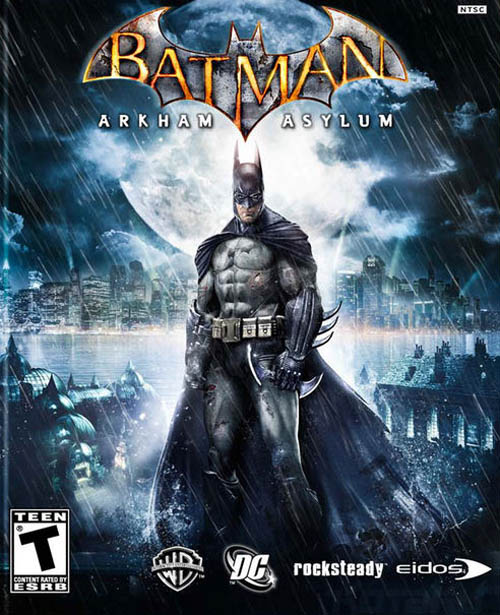
Batman: Arkham Asylum

Arkham Asylum’s principle accomplishment is the one thing I was sure it would fail at: the player really feels like Batman, and, when I say Batman, I don’t mean your average guy wearing tights, but rather the semi-invincible master-at-everything who can take the matchup Batman v. Anything and Everything and win every time.

A big part of that is the fighting system. One man is never a problem in a hand to hand fight with Batman, so the game becomes more about crowd control, combos, and flow than the specific trading of blows. The sheer power that is impossible to not feel as you twist through the air from one end of the room to the other (landing to savagely smash a criminal down with a beautifully rendered spin kick, and then leaping off again to drive your fist into the skull of another foe on the other side of the room) is immense, but what makes the experience is the feeling of dancing on the tip of a needle. You’re invincible unless you fuck up, but a single misstep yanks back into normal time, where everything runs like sludge and it feels like everyone in the room is about to break every not-so-fragile bat-bone in your body.

Unfortunately, that feeling is an illusion. Batman has a prodigious amount of health, and anyone with a rudimentary understanding of the combo system should never have any trouble with the campaign’s fights. Later on, the game tries to remedy this by the inclusion of knife and baton armed thugs, but both only succeed to badly break your flow for the first two appearances and then simply become targets to take out as soon as possible, before you resume your general rampage. To make matters worse, the Challenge maps offer exactly what the campaign fights needed: huge swarms of enemies, a leap so obvious that I’m unsure how whoever did the details of the campaign maps never thought of it. Unfortunately, you’re likely to discover the Challenges after doing a quarter at best of the main game, and once you play those adrenaline-infused fights for long enough to start getting thirty hit combos with ease, the toughest encounter in the campaign begins to seem like a laughable tutorial.

The other half of the Batman feel is the stealth aspect, though the developers have stated that they prefer the term Predator to Stealth; while that sounds like a meaningless distinction, it pretty much sums up those parts of the game. The first few times the player meets enemies armed with guns, they freak the hell out. Suddenly, there’s a foe that’s so much stronger than Batman that the difference between the two is almost comical. And yet, after an encounter or two, the player is ready to strike from the shadows, orchestrating traps and pulling off hit and run tactics. It’s true that the stealth, like the combat, never really evolves from what it starts out as, but that’s far from a deal breaker, because it’s awesome to begin with. The Predator missions are, without a doubt, the highlights of the game, and I soon found myself playing far longer than I intended to because I knew there had to be a stealth section coming up, and I simply had to experience it.

Finally, exploration is quite fun. This aspect of the game is hampered by the general lack of respawning enemies when you respawn an area later, eventually making it so that exploration's more footwork than adventure. Still, the grappling hook is extremely well done, and flying down from some high perch is great fun (and is even better when there's some squishy inmate/mortal down there to land on). The game's collectibles are generally fairly well placed to be a bit of a challenge but not impossible, and most of the important ones (IE, the ones that unlock challenge maps) are easy to get without too much trouble, even if the occasional one will have you scratching your head with three different guides and two maps spread across your desk.

As for the game's story, it's about what you'd expect. It primarily serves to get all the villains roped in so that Batman can beat them up, and the ways in which that's done do occasionally seem contrived, but there're no obvious false notes, and the Joker is amusing enough to gloss over any weaknesses.

Every once in a while, events come to a head and the game throws a gigantic set piece at you. Now, this is a Batman game. The Batman universe is filled with fun villains. By all rights, the boss fights here should be awesome. They are not. They are terrible. The vast, vast majority of boss encounters go exactly like this: 1. Huge Enemy 2. Huge Enemy Runs at You 3. Throw Batarang and Dive Away 4. Huge Enemy Hits a Wall 5. Every Few Times Huge Enemy Hits a Wall, jump on its back and hang out for a little while.

Now, the initial Huge Enemy (Bane) fight wasn’t too bad. Generic, but entertaining. The fights with the other, more colorful villains were bad. Poison Ivy is defeated by throwing batarangs for about five minutes, dodging every once in a while. Croc is defeated by walking…really…slowly…for…a…really…long…time… and then hitting him in the face with a batarang. The first is banal, the second tedious. But those are nothing to the Huge Enemy/Bane-clone fights that are repeated again and again and again and again and again.

The absolute pinnacle of those occurs between two thirds and three quarters through the game. It’s two Huge Enemies v. One Batman.  Every thirty or forty seconds, one of them charges. You hit them with a batarang, and, when they hit the wall, they are stunned for something approaching thirty seconds or more. It’s absurd. The two almost never attack together. You’ll wait two or three minutes before charges, at times while they stomp around and occasionally chuck some slowing moving crud at you. Then, when you finally take away one of the three health bars that each of them have, you have to jump on that one’s back. If you don’t, it gets the health back…somehow. When you jump on its back, you simply ride it around for an ungodly long time with absolutely nothing to do. The fight took over half an hour (without dying), and it occurred to me near the end that, if I died, there was no way in hell I was ever playing that fight again. Thankfully I didn’t die, but I can safely say that that one boss battle was the absolute least fun I’ve ever had playing anything that dared to call itself a game.  

In the end, Arkham Asylum is a fun game. It’s got some good atmosphere, and I usually consider that the most important thing, but that same atmosphere stays exactly the same for the vast majority of the game. There’s a difference between being powerful and being immortal, and combat here often feels more like the latter, compromising the feel of the world while you sip your coffee in between attacks. Of course, those are the good parts, because when Arkham Asylum tries to break out of its own mold, it falls on its face so hard that you can hear the bones break. If you’re interested in Batman, or want to play a game with a great stealth concept, or just want some fun, you won’t be disappointed in this. Just don’t expect anything too great. 

Saturday, April 17, 2010

Richard K. Morgan Doesn't Play Well With Others

I mean, play Gears Of War; those characters, you can’t imagine them doing anything besides running around shooting monsters.

This is certainly not the first time Morgan’s stirred up some controversy, but everything’s really coming together now. Morgan’s previous target was Tolkien, though I think that he made a few fair points (and, say what you will about the quality of the novel, The Steel Remains did address those points). This time around, it’s even harder to avoid thinking that Morgan’s just doing his best to rile people up.

Of course, it doesn’t help that the people reporting on this couldn’t possibly have slanted their articles more. I’m primarily referring to is this, which has really mastered the art of taking things out of context. Yes, Morgan did say:

Halo is full of these bullshit archetypal characters and there's no real emotional effect.

but it wasn’t an unprovoked assault. In fact, the question he was asked was:

Do you think getting that greater depth of character is made more difficult by the faceless nature of Nanosuit 2? Master Chief syndrome, you might call it.

It’s a question about deep characters in videogames and specifically asks whether Morgan thinks he can overcome what the interviewer thought was the problem with Halo’s characters. It would be a bit odd for Morgan to not discuss Halo’s storytelling merits at that point, would it not be? Morgan is saying that he doesn’t anticipate a problem, because he doesn’t think that was what was wrong with Halo. Not seeing the malice here, sorry.

The defense in the comments of both that article and the one here is frequently just as off base. What is being accomplished by spouting games like Mass Effect (which may not be the best choice to contend charges of archetypical writing)? Morgan is not saying that no games have good stories; he is a fan of Bioshock, for one. Other comments say that gameplay is more important than long cut scenes, though Morgan’s already answered that:

…a 20-minute cut-scene is embarrassing.

It seems like very, very few people commenting have actually read the whole interview. Either that or their minds simply shut down after the Halo comment, and they started looking for stuff to hate:

What is wrong with comic books BTW? Do writers who deal with a character like the Joker automatically suck as writers because it is "bullshit, man... that's comic book?" Tell that to Allan Moore, Frank Miller and Grant Morrison. Or Warren Ellis. Or Neil Gaiman. Or Brian Michael Bendis. Or Mark Millar.

I know, Morgan must really hate comic books.

Morgan is not saying that story triumphs over gameplay; he held up Bioshock as an example, a game with the best integration of the two concepts that I’ve ever played, not Heavy Rain. Morgan isn’t even insulting the games, just their stories, which makes comments like:

Halo games were always supposed to be light on story, heavy on environment: big weapons, awesome vehicles, wide-ranging and artistic tech, epic landscapes. That, to me, is Halo.

utterly pointless. No one is attacking smashing someone in the face with a speeding Ghost; they’re just saying that there isn’t all that much behind Halo’s story. And I can’t disagree with him there. Ignore the books for the moment; the discussion’s about the video game Halo. Are people really trying to tell me that Sergeant Johnson, characterized by being tough and chewing a cigar, is a deep character? Really?

Like last time, I can’t shake the feeling that Morgan’s setting out to infuriate as many people as he possibly can, but, also like last time, I can’t really deny any of his points. Unfortunately, the odds of my computer being able to run Crysis 2 are laughable, so I suppose I’ll never get to see if he lives up to his own hype.

UPDATE

Morgan himself has come back to comment on the misrepresentation of his opinions:

...the gaming press has taken a series of freely expressed opinions from me, borrowed selectively for negative content, created misleading titles around said comments and so bolted together an image of me as some arrogant interloper who thinks my writing is superior to anybody else’s working in games.This process reached a head yesterday when Koku Gamer started openly misrepresenting my views on the game Uncharted 2 by substituting the views of another, entirely different person working at Crytek and claiming his opinions were mine. The good news is that the view they’ve claimed I expressed is so diametrically opposed to other well-reported comments I made about Uncharted 2 (in short, that it was superb), that Koku are just going to end up looking like the fuck-wit lying assholes they clearly are.

I guess that's the problem with twisting everything someone says; when you go too far, they can prove you're wrong and throw the whole thing in your face. Thumbs up for journalistic integrity?