Showing posts with label Vampire. Show all posts

Tuesday, August 23, 2011

George R.R. Martin - Fevre Dream

Released in 1982, Fevre Dream is George R.R. Martin's third novel. While much of his early work is Science Fiction, this is a historical Horror novel, one as concerned with steamboats upon the Mississippi as it is with the vampires it contains, and one that proves as adept at conveying the majesty of 19th century America as A Game of Thrones was at showing us a certain pseudo-medieval world. Yes, this is a vampire story, but it is anything but a shallow imitation of 'Salem's Lot or any of the genre's other classics.

Like all of Martin's work, Fevre Dream is a story of characters. Abner Marsh is a large and honest man, someone slow but bright, the ugliest man on the river (p. 11) and one of its biggest dreamers. He's a steamboatman through and through and has served in every position up tom and most certainly including, captain, but he's now lost just about everything save sympathy due to crushing ice and cruel fate. Abner is a gruff character not much given to warmth or gentleness, but he's a good man that refuses to bow down to circumstance.

Into the picture comes Joshua York, a suave man of indeterminate age, strange hours, and stranger companions. He has a proposition for Captain Marsh: York will supply the money for a steamboat if Marsh is willing to captain it for him. And if Marsh is willing to never, ever question the peculiarities of him or his companions. So their partnership begins, with Marsh kept in the dark. Of course, as any reader of horror worth their salt should be able to guess within a page of their meeting, Joshua's more than he seems. But that does not mean that the novel soon devolves into empty chase scenes. No, Joshua and Abner's relationship is far more complex than that. The chemistry, and eventual friendship, between the two is breathtaking, even while it has to grow around the holes in their knowledge and the mistrust that they can't help but feel.

Damon Julian and Sour Billy Tipton complete our list of characters, and their relationship could not be more different. Julian is the most powerful living vampire, and perhaps the eldest, while Sour Billy is the human he uses to do his bidding. Their relationship is one of greed, with each intending to exploit the other for all that they are worth, and each interacting with others entirely through fear.

The conflict between York and Julian is the central thread of the novel, but far from its only focus. Martin's pace here is slow, drifting down the course of the story and seeing all there is to see rather than sprinting through. The first half of the book, in fact, is almost devoid of direct conflict, instead focusing on setting the scene and building the atmosphere. Martin is able to characterize with only a handful of sentences, and his descriptions are rich and stately, filling the pages with a world over a century old that fills as vivid as the reader's own:

Even empty of carpeting, mirrors, and furniture, the long cabin had a splendor to it. they walked down it slowly, in silence, and in the moving light of the lantern bits of its stately beauty suddenly took form from the darkness, only to vanish again behind them: The high arched ceiling with its curved beams, curved and painted with detail as fine as fairy lace. Long rows of slim columns flanking the stateroom doors, trimmed with delicate fluting. The black marble bar with its thick veins of color. The oily sheen of dark wood. The double row of chandeliers, each with four great crystal globes hanging from a spiderweb of wrought iron, wanting only oil and a flame and all those mirrors to wake the whole saloon to glorious, glittering light. (pp. 32-3)

That splendor, however, can be deceptive. Numerous characters are enamored with beauty, and good is closely aligned with the creation of beauty. And yet beauty is what so often leads to evil, what draws both vampires and thieves. Darkness, too, frequently lurks behind beauty, and the splendor of the Fevre Dream and the river towns it passes through is soon tainted by what lurks underneath: "This city – the heat, the bright colors, the smells, the slaves – it is very alive, this New Orleans, but inside I think it is rotten with sickness." (p. 130) In that way, the majesty of the novel's opening is subverted as its core turns out to be rotted and sick. Great works are built on the backs of slaves, noble characters may be filled with evil, and the beauty of Julian and the ugliness of Marsh provide no indicator of the man beneath the skin.

Fevre Dream, at first, seems a specimen of character driven horror, focusing on the personal struggle between Joshua York and Damon Julian and the darkness that comes from within men. But, as time passes, it soon becomes clear that the conflict is not between those within our brightly lit steamboat and those against another but rather our brightly lit steamboat against the entirety of the darkness without and within: "I thought him evil at first, a dark king leading his people into ruin, but watching him…he is ruined already, hollow, empty. He feasts on the lives of your people because he has no life of his own, not even a name that is truly his. Once I wondered what he thought of, alone, all those days and nights in darkness. I know now that he does not think at all. Perhaps he dreams. If so, I think he dreams of death, an ending. He dwells in that black empty cabin as if it were a tomb, stirring form it only at the scent of blood." (p. 291)

Even as he draws horror from the same wells as Lovecraft and his cohorts, however, Martin's conclusions are vastly different from the cosmic pessimism of the Weird Tales originators. For Martin the unassailable power of darkness is plain, but that does not give you an excuse to surrender. Here, virtue can only be found among the choices we make when faced with inevitabilities: "Choice, you said," he volunteered finally. "That's the difference between good and evil." (p. 178) And so, despite the ephemeral length of their lives, and the vanishingly small nature of their chances, Martin's characters become romantic heroes.

Good choices alone, however, are not enough. Time and time again, Joshua faces Julian in battle, and he loses each time, because Julian is unconstrained by conscience and Joshua is not: Joshua had drugged his own beast, had tamed it to his will, so he had only humanity to face the beast that lived in Julian. And humanity was not enough. He could not hope to win. (p. 354) Intentions are not enough to earn triumphs in Martin's world. To achieve something beyond empty heroics, Martin's characters must, to some extent, embrace the very barbarity that they fight, and, therein, comes the almost insurmountable challenge of drawing the line between strength to fight evil and becoming evil oneself.

Throughout, Joshua York is defined by defying the status quo. For millennia, vampires have simply fed. Driven by their need to kill – the red thirst – they ignored morality and took what they required. York does not see them as evil in that period. As he says, Without choice, there can be no good nor evil. (p. 177) But now York has found a cure, a way to banish the red thirst without the need to revel in murder and blood. Only now can he condemn his fellow vampires, those that choose not to abandon their old ways. As such, it is fitting that his greatest foe, Damon Julian, is no longer a prisoner of his thirst. The too-human need to do harm proved ephemeral in him, and, like Joshua, he is no longer bound by it. Yet he still chooses to do harm.

Martin, of course, extends the metaphor to encompass humanity as well. York was born around the time of the French Revolution, when superstitious peasants executed his father while he and two servants escaped. The father, far too much a creature of the night to believe in anything more damning than amorality, does not blame the peasants who come for him: "They cannot help themselves. The red thirst is on this nation, and only blood will sate it. It is the bane of us all," (p. 154) words later used to describe the Civil War that explodes in the background of the narrative. York rejects that idea, claiming that humans are under no compulsion from the thirst; only an evil nature made [them] do as [they] did. (p. 171)

So, from all of this, Martin's point seems to be that we are not good or bad because of our circumstances but because of our choices and that, no matter the odds, we must not allow ourselves to be swept up by evil. Alright, that all makes sense, and it's a message that's well conveyed – except, that is, when Joshua goes and muddies everything up. Traditionally, vampires sort their hierarchy and prove their dominance with a contest of wills, with the loser subjugated to the winner forever, or, at least, until a stronger vampire comes along. Joshua prefers not to use this method, instead attempting to allow his followers a choice. This most certainly fits with his character. After all, vampires would hardly have become a force for good if they only ceased murdering due to being strong armed into the decision. When they choose to defy Joshua, however, he is not above challenging and defeating them. That, too, fits well with the novel's themes: when the right path cannot be achieved by intentions alone, force must be used to ensure that evil does not triumph.

These mechanics become troublesome, however, when Damon Julian enters the picture. First, Joshua attempts to sway him with words, and then with strength. Both times he fails. Joshua, of course, does not surrender. Though he is outmatched, he battles Julian again and again and refuses to give into Julian's immoral way of life (death?). And yet, when it comes to Julian's other followers, Joshua expects nothing of the kind. There comes a point when Abner decides that he will attack the vampires by day with armed men and explosives. Instead of agreeing to the destruction of an evil he cannot vanquish, Joshua says that, if he must, he will fight beside his fellow vampires, because they are not truly evil, for [Julian] controls them. (p. 302)

But is that any excuse at all? After all, the truly evil Damon Julians of the world are rare. Yes, men do instigate great atrocities, but the vast majority of the damage is done by those neither good or evil that simply follow orders, those – to put it as Martin might – swept away by the red thirst that cannot help themselves. (p. 154) Those French peasants so long ago were not scheming masterminds. To say that those carrying out the works of evil men are not only not in the wrong but also deserving of protection is bizarre, a seeming direct contradiction of Joshua's earlier (and later) refusal to accept circumstance as an excuse for evil.

Despite that one inconsistency, however, the buildup of ideas and tension in Fevre Dream is almost flawlessly executed, the world of the novel steadily and inevitably darkening as the characters' dreams fade out of sight and as their nightmares take the stage. The book's middle is a succession of climaxes, followed by the laxly paced and decades-spanning Fevre Years section. On my first read, some years ago, I thought this to be the novel's main weakness. Now I'm more conflicted. This is a great character moment, as well as a thematic one, but it's undeniable that it comes at the expense of much of the prior chapters' tormenting tension. The climax that comes after the lull, however, is anything but an iffy proposition, featuring a fantastic literalization of Joshua and Julian's battle of wills and of their moral philosophies while, around them, the other vampires awake as night dawns.

When it comes to setting and pacing, Fevre Dream might seem an anomaly of sorts in Martin's catalog, but it's linked to the man's other work by the themes it explores and the fantastic quality of its execution. The book's epilogue takes place decades later, in a graveyard overlooking the Mississippi River as the river rolls on and on, as it has rolled for thousands of years. (p. 361) Our characters have departed, the changes that they wrought have been forgotten by almost all, and the very world that they lived in has faded. But we can still see that they made a difference. I've read Dracula, 'Salem's Lot, and more, and I don't think that we've ever, or will ever, see a vampire novel that can equal Fevre Dream.

[Note: all page numbers from the numbered Subterranean edition]

Tuesday, August 9, 2011

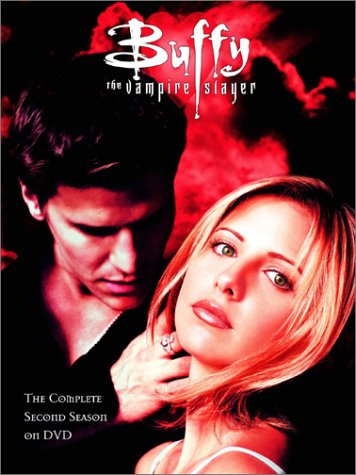
Buffy the Vampire Slayer: Season Two

The first season of Buffy boasted a mixture of imaginative storylines and tired plots, a group of characters that varied between fascinating and shallow, and special effects that were generally rather cringe worthy. The second season of Buffy, on the other hand, fixes almost every problem that marred the first. A warning before we continue, though: this review will include SPOILERs for most episodes discussed.

After all that improvement-trumpeting introduction, I'd like to say that the second season explodes out of the gate. Alas, it does not. The opening episode – When She Was Bad – seems hell bent on milking the first season's weakest aspects for all they're worth. Cheesy vampires come up with a plan to resurrect a defeated and cheesy looking villain, and the world quakes (I suppose). Buffy, newly returned from a summer vacation while all the vampires too took a break, is traumatized by the Master's death, and those around her theorize that, because of that, she's decided she has to be invincible. This would all be a lot more effective if, in the end, Buffy didn't turn out to be essentially invincible and defeat all the vampires single handedly, save for the Annointed One who scurries off to enact more dastardly schemes. Yawn.

In fact, the season doesn't really kick off until the third episode, where things go from overblown to exemplary with all the speed of a jet engine. So what changes? Spike. Played by James Marsters, Spike is a relatively young and sadistic vampire that comes to Sunnydale to wreak havoc and find a place for his injured vampiric paramour, Juliet Landau's Drussilla, to recover. Spike is like nothing that's appeared before in the show, a vampire draped in sarcasm and irreverence, as exemplified by his scorn for his fellow vampires: If every vampire who said he was at the crucifixion was actually there, it would have been like Woodstock. (School Hard) But Spike isn't just a witty monster. No, Marsters imbues the character with so much charisma that the viewer can't help but love him, and he grows more complex yet when one factors in his humanizing relationship with Drusilla. Soulless demons the two might be, but they clearly love each other all the same. As for Drusilla, Landau's portrayal of her is excellent, at once vulnerable and creepy, demented but somehow understandable. At the end of the third episode, Spike slaughters the Anointed One and takes over his lair, and the change couldn't be a more welcome one.

Much of the main plot is developed through the season's three two part episodes. The first, What's My Line, brings the main portion of Spike's storyline to a climax. In order to revive Drusilla to full health, Spike kidnaps Angel and plans to sacrifice him to her. To keep Buffy off his back while he does this, he evokes the Order of Taraka, a cult of deadly assassins. The double episode is filled with genuinely creepy moments and numerous instances of often surprising character growth, for Xander and Cordelia in particular. At the episode's conclusion, Drusilla is restored, Angel wounded, and Spike crippled. It's a mark of Marsters charisma that, even after being confined to a wheelchair, Spike still manages to steal every scene he's in.

The second group, Surprise and Innocence, contains a turning point for the season even more significant than the crippling of Spike. To celebrate Drusilla's birthday, she and Spike prepare to summon the Judge, a demon designed to cleanse the earth of humanity. The really interesting part, however, doesn't come until the very end of the first episode. After Angel and Buffy make love, the Gypsy curse mentioned in the first season causes Angel to lose his soul, turning him to Spike and Drusilla – and against Buffy and her allies.

Finally, Becoming parts one and two wrap up the season with a mixture of epic action and excellent character moments. Angel attempts to bring to life a world ending demon as Buffy and co attempt to restore his soul. In the middle of all of this, Spike has a change of heart and, after episode after episode of quarrelling with Angel, switches sides, saying to Buffy: We like to talk big, vampires do. 'I'm going to destroy the world.' That's just tough guy talk. Strutting around with your friends over a pint of blood. The truth is, I like this world. You've got... dog racing, Manchester United. And you've got people. Billions of people walking around like Happy Meals with legs. It's all right here. But then someone comes along with a vision. With a real passion for destruction. Angel could pull it off. Goodbye, Piccadilly. Farewell, Leicester Bloody Square. You know what I'm saying? (Becoming, Part Two) Of course, all that might make more sense if he hadn't summoned the Judge half a season earlier, but the twist is still fascinating, and further goes to show how different Spike is from your average vampire. Most of the climax is what you'd expect, but the exception is Angel's restoration moments before Buffy must kill him, an emotional high that's likely to leave any viewer more than a tad shellshocked.

It's in Becoming that the core of Whedon's beliefs, and the show's thematic heart, come clear. As things reach their bleakest, a demon from the sidelines tells Buffy: Bottom line is, even if you see 'em coming, you're not ready for the big moments. No one asks for their life to change, not really. But it does. So what are we, helpless? Puppets? No. The big moments are gonna come. You can't help that. It's what you do afterwards that counts. That's when you find out who you are. You'll see what I mean. (Becoming, Part One) Buffy isn't a hero because she was chosen – through no fault or desire of her own – to be the Slayer. She's instead a hero because of how she acts as a Slayer, and because of the decisions that she makes once the inevitabilities of her life have played themselves out.

As is no doubt obvious from the outlines of just those three (double) episodes, Whedon is utterly unafraid to shake up the framework he's set up, and it's from that that the show's best moments come from. It's no longer a fair assumption that all good characters are safe, and the season's evolutions are often impossible to predict. Spike, audience stealing bastard that he is, is crippled, and Angel, love interest and major character, becomes an antagonist and then dies. The uncertainty that soon sets in rapidly becomes one of the show's greatest strengths.

The side stories in season two are almost universally at the high level set by season one's best episodes. As before, the various beasties that Buffy encounters are each metaphors for an aspect of her teenage life. Reptile Boy, for instance, shows us a group of frat boys that feed female sacrifices to their god – a giant snake that lives in their basement. Go Fish deals with a swim team that takes steroids. Before long, the members are themselves turning into monstrous aquatic creatures. These storylines are well executed, but the best part of them is often their connections to the rest of the show. Lie to Me, for instance, focuses on a group of humans who've discovered the existence of vampires – and have decided to worship them. The members of the cult are expertly depicted, coming off at once as desperate, deluded, and almost understandable, and the conclusion is – like everything featuring Spike – fantastic. That being said, Whedon's attempt to add a measure of moral ambiguity by making the human villain suffer from a terminal illness falls rather flat. No, Whedon, atrocities cannot be forgiven due to one's nearness to death. Still, the episode's excellent throughout. Others, such as Halloween, Bad Eggs, and Killed by Death include the vampires in more tangential rolls, but the blurring of side and main plots serves to keep the stakes high and the world believable.

That being said, the world does have the occasional gap in troubling moment above and beyond everyone in Sunnydale's herculean ability to forget mass murder within the hour of the blood drying. Principal Snyder is as enjoyable as ever in his quest to remove the 'pal' part of his job description, but the knowing discussions he has about the vampiric problem in episodes like School Hard and Becoming raise some awkward questions. First, if Snyder's aware enough of vampires to have a "usual story" in School Hard, why did he attempt to flee right into their clutches mere moments before? And, more importantly, why is he so hellbent on tormenting the Slayer in his midst if he knows the importance of her job? Furthermore, while the area around the Hellmouth is a fairly coherent place, the rest of the world is a bit sketchier. When Spike decides to evoke the aforementioned Order of Taraka to kill Buffy, one of his henchmen asks if that isn't "overkill." Excuse me? If there's one Slayer, who's the most dangerous thing since the sun for anyone of vampiric persuasion, why on earth wouldn't they slay her as quickly and surely as possible every time? 

Finally, in the episode Halloween, Buffy attempts to reconcile Angel's relationship with her to his past and decides she must be lacking in comparison with the noblewomen he no doubt lusted after in his youthful days. Well, alright, that doesn't seem too likely, but Buffy's a teenaged girl who's never met a Victorian noblewoman, so the emotions works. When Angel hears of this, however, his answer is: I hated the girls back then. Especially the noble women. […]They were just incredibly dull. Simpering morons, the lot of them. (Halloween) I appreciate the sentiment, Angel, but the idea of the nobody human Angel's shown as in Becoming's flashback ever considering noblewomen as romantic partners is a tad jarring to anybody who views the past as anything but an extended high school dance. Still, the first of my two complaints stem more from a lock of information than outright flaws, and the third is hardly major.

The show's villains are not the only recurring minor characters. A problem for me in the first season was that, aside from the show's core cast, the rest of the school essentially consisted of blank bystanders who could be counted on to be either one shot villains, dead, or both by the end of their introductory episode. It still holds true that any new character is a beasty until proven innocent, but the greater length of the season allows the writers to often show us characters and items a fair while before they grow important. The greatest example of this is Seth Green's Oz, the guitarist who begins to date Willow midway through the season. Long before the two know each other, however, the character makes appearances, and, when it's time for him to join the main characters and especially step into the spotlight for the episode Phases, he's well established and sympathetic.

Any viewer quickly comes to understand the general structure of almost any episode: there's a menace, Buffy punches the menace, the menace either flees or dies. A large part of what makes the formula work so well is the impact all of this has on Buffy's character. Her arc is still primarily concerned with her attempts to balance being a normal girl and the slayer, but the brutality of the latter has now come to affect the former, and Buffy herself has to face the consequences of the violence she uses. That leads us to Ted, the hands down best episode of the season (and the show so far). Instead of focusing on one bogey or another, Ted builds a compelling story out of Buffy's personal life. Her mother – played by Kristine Sutherland – has a boyfriend, and the two have grown close. The newcomer, Ted, wins over all of Buffy's friends, but Buffy can't get over her dislike.

As the episode progresses, Ted threatens Buffy with greater and greater punishments. What makes this so effective, especially in contrast, is that these are emotional highs achieved without any more than powerful writing. As Ted continues to harass Buffy, he eventually discovers her diary – and more than a few mentions of slaughtering creatures of the night – and says that he'll have her committed if she ever dares interfere with him. So Buffy reacts as she does throughout the season: with violence. She kills Ted, but the cheery climax of slaughtering a vampire does not follow. Instead, Buffy is ostracized and under suspicion, and she's forced to deal with the consequences of murder. Of course, this is where Whedon's fantastic ability to have his cake and eat it too comes in. After he's extracted everything he can from Ted's death, he has Ted return as a monster, exonerating Buffy from that particular transgression but very much retaining the lesson that she is capable of such things. Oh, and as if all that wasn't fantastic enough, the episode's detective and martial climaxes are some of the season's best, too.

The other main dimension of Buffy's arc is her relationship with Angel. For the most part, Sarah Michelle Geller and David Boreanaz manage to make their interactions fairly believable, if never quite heartwarming, though there is certainly the odd and painful appearance of melodrama: Angel, when I look into the future, all I see is you! All I want is you. (Bad Eggs) To be fair, one gets the sense that the over the top nature of much of her relationship with Angel is intended, as a reflection of most teenage romances. Later developments in the season, however, rely heavily on their love being true, not just a temporary fling, so the parts played for excess or laughs feel odd when located near the more touching scenes. Oddly enough, it's in the scenes where Angel's an antagonist that their former relationship is the most believable. The villainous Angel works well both due to actor David Boreanaz's skills and because he does, after all, have motivation to engage in the kind of psychological, cat and mouse battle that all of the show's antagonists have engaged in to a greater or lesser degree. For him, the roundabout methods of attack make perfect sense, and episodes like Passion and I Only Have Eyes for You do an excellent job conveying a love gone horribly wrong.

The season one character that changes the most here might be Cordelia. Before, she was a hilariously over the top school bully with the occasional glimpses of personality. Over the course of the second season, however, she becomes a character on par with the others, develops a believable relationship with Xander, and most certainly manages to maintain her core bitchiness. Giles, also, grows considerably in this season, as evidence of his darker past comes to light, first in the episode Halloween and then, later, in The Dark Ages. Though the modern incarnation of everyone's favorite Watcher is still a stark white, it's quite fascinating to see him wrestling with the consequences of his own actions. His love interest, Jenny Calendar, also becomes a far more interesting character than she was before, and the way that their relationship changes between episodes is always believable and interesting. By the time of the episodes in which she comes to the fore – Surprise/Innocence and Passion – Jenny's got as much agency and mystery as any of the show's main characters.

At the season's end, Spike's left, Drusilla's gone, Angel's dead, Jenny's been killed, and a wanted Buffy has fled Sunnydale after being kicked out of her mother's home. Perhaps the biggest change, however, is my appreciation for the show. I'll be watching season three as soon as I finish this review – not because of promises that it will get better, or because I feel obligated as a reviewer, or because I'm out to pass the time – but because I genuinely care about every one of the show's characters.

And… done. Time to get out those DVDs...

Standouts: Ted; What's my Line?; Passion; Becoming; Lie to Me

Friday, December 10, 2010

Justin Cronin - The Passage

Before she became the Girl from Nowhere – the One Who Walked In, the First and Last and Only, who lived a thousand years – she was just a little girl in Iowa, named Amy. Amy Harper Bellafonte. (p. 1)

The Passage is probably, at least in terms of marketing and publisher pushes, the biggest release of the year, a book covered in at least some form on almost every blog, one of the few speculative fiction books to, at least to some extent, break out of the genre crowd and infiltrate society at large. Does it deserve its accolades? In part.

Let’s get this out there right away: Cronin can write, and he can do character very, very well. In many ways, he reminds me of Stephen King, and I don’t just mean the Stand’s apocalyptic setting. Stephen King, especially in The Shining, has a habit of revealing characterization by circling the same points, but getting closer in each time. Cronin does the same thing here.

The first section of The Passage is where the main comparisons with The Stand come from, and it’s easy to see why. That being said, Cronin’s apocalypse is far vaguer than King’s and never deviates from expectations. The world is fucked up in every single way imaginable, and Cronin does a good job implying the changes without ever going into full scale infodump mode (Like the characters taking a detour to avoid the Federal Industrial District of New Orleans (p. 65)), but we’re never really presented with a situation that couldn’t be happening fifteen minutes from now.

The focus is not on the actual end of the world, in this section, but on the period leading up to it. There are genetically engineered super hero stories everywhere you look, vampirism being the super power in question here, and I think everyone has already seen the scene where the vampires break out in a dozen science fiction and horror stories already. Cronin does little to distinguish the actual events of their escape – the security procedures are, though outwardly capable, pretty much an in joke to anyone who’s ever read a horror novel – but instead makes us care through his characters.

Wolgast is an FBI agent with marital problems and moral qualms. When asked to bring six year old Amy to the secret research facility, he realizes he can no longer go through with what he’s doing and decides to save her life. Carter is a murderer promised one last chance in exchange for being made a human (soon to be vampiric) guinea pig. Grey and his coworkers are prior sex offenders, drugged to the eyeballs and working as manual labor as the vampires work their way into their minds. None of these threads are particularly original, and the reader can always either see the end of a plot thread ahead of time or take comfort in the fact that the few remaining unknowns will be swept away by what is known (apocalypse and all that entails). Still, Cronin’s gift is making you care, in circling around and around and establishing a scene well enough that, even if you know where it’s going to end, you’re still entranced.

By any objective measure, The Passage is filled with extraneous sections. The book opens with Amy’s mother and travels through teenage pregnancy, murder, and the eventual abandonment of the baby before the character falls off the face of Cronin’s earth, and that scene is far from unique in that regard. Yes, it could be argued that such a thing is filler, wholly unneeded, but, on the contrary, I think those passages are the soul of the book. The first part of The Passage is not a story of what happened to the world (we know already), nor of how it got that way (we can guess) but rather of the people swept along, and the time Cronin spends again and again on the most minor of characters is what gives potency to his earth shaking events.

After the end of everything, and a few transition segments, we enter the world that we are going to be spending our time in. The Colony is a far more inventive setting than the military base of the opening, and though aspects feel too outlandish at times, the overall set up is quite clever and the characters that populate it fascinating. Moving through similar structures as he did in the first part of the novel, but on a whole different scale, Cronin introduces us to the denizens of the Colony in a circuitous manner, gradually bringing in more and more perspectives as he ups the complexity of life in the small, isolated world. Though the transition to a whole new cast is at first difficult, Cronin’s construction of immensely understandable people living bizarre lives is effective at grabbing and holding our sympathies.

At the colony’s heart is the knowledge is the knowledge that they were all that is left in the world, but they don’t reveal this knowledge right away. Instead, in an attempt to allow their children to experience a carefree and blissful childhood, all knowledge of the end is kept secret from their kids, who dwell and play safely in the Sanctuary. Then, as they come of age, they’re told: a miniature apocalypse that scars every one of them and repeats itself again and again with each member of the society.

The Sanctuary is only one of the places in the novel where the bond between parent and child is explored. Cronin’s said that the inspiration for The Passage was his daughter, and that shows in the text. From Amy and Wolgast (and Wolgast’s short lived natural child) to Amy and her biological mother, Mausami and her father, the concept of the Sanctuary, and Babcock and his followers, Cronin approaches the concepts of parenthood and progeny from a dozen different angles, a variation of moving apart and responsibility that characterizes many of the relationships within the text.

It’s common knowledge that, the second you see its monster, it stops being so scary. There are exceptions, but, as a general rule of thumb, if you’re gunning down monsters, it’s not a pure horror story but, at best, a horror/action hybrid. When you show that the monsters can die, we stop being so frightened. If it can happen once, it can happen again. Cronin knows this. The opening’s scientific study of the vampires reveals a bizarre litany of capabilities, but no true understanding. The apocalypse is the world falling away off screen. The opening sections of The Colony show banks of spotlights looking into the dark and watchers waiting for an unseen foe. When a character steps outside for the briefest of seconds, just a footfall outside of the lighted cordon, the reader is terrified. Virals (Cronin’s name for vampires) are everywhere, unstoppable, and the reader knows that, any second now, they’re going to get you.

But, when the virals are actually seen, they don’t live up to their horrifying reputation. They’re action movie enemies, quick and strong but able to be put down by a shot to their sweet spot, each named character being able to take on, on average, ten or fifteen of them. The virals sudden lack of potency is a symptom of a deeper problem. Cronin’s set ups are immaculate, deep, vivid things. When he moves away from the set up into action, though, the novel loses its prodigious feeling, the text loses its weaving complexity, the characters become bellowing warriors rather than gradually illuminated enigmas.

Now, that’s not to say that Cronin is bad at plot motion. He’s not, but he’s not great at it either, and the payoff is never the match of the set up. When the vampires break free and ravage the military base, it’s a scene of blood splattered walls and distant screams that’s enjoyable but never the equal of the gravitas that was summoned during the testing. The road trip is well done for the most part, but its sheer length leeches the power of any one stop. Haven is creepy and powerful, but the cartoonish climax deprives the scene of much of its power. Etc.

Simply put, there’s a massive discrepancy between how Cronin makes you feel about his world and the actual facts of the world. Don’t get me wrong, it’s great when an author can make their setting feel dangerous, empty, or whatever it is they’re going for. There are few things better. But, as counterexamples and one in a million shots pile up, it becomes increasingly clear that the virals are not the unstoppable force they seemed to be, that it is perfectly possible to move about safely at night, that technology and civilization are not destroyed (because it’s hard to walk ten steps without bumping into a fuel depot or abandoned military base), that the world is not empty (because it’s hard to properly get yourselves locked in with no way out without bumping into some coincidentally travelling force of other survivors), and so on.

Finally, the sheer size of the novel plays against it. There are scenes that are perfectly fine scenes that are unaffecting for the simple reason that we’ve seen them, or at least something comparable, before. In this very novel. By the tenth close call, it’s difficult to think the protagonists are actually in danger, though that perception may not be accurate; Cronin is rather even handed with his deaths.

The Passage has been billed as a monumental work, and, as such, has been compared to everyone under the sun, providing they’ve included some sort of desolate roadway in their work. I feel the need to address some of the hype surrounding this novel. Now, I’m not talking about the quality here; that’s a personal call, even if I don’t necessarily agree with it. What I am talking about are the comparisons.

The first author often cited is Stephen King, and I think that’s a rather fair way to understand The Passage. Beyond the similarities I’ve already spoken of, both authors use the mundane in order to suck us into the world, illuminating strange situations with minutia and colloquialisms, such as (in Cronin’s work): It’d been almost two years since Carter had been off H-wing – H for “Hellhole,” H for “hit my black ass with that stick some more,” H for “Hey, Mama, I’m off to see Jesus any day now...” (p. 28-29)

In fact, Cronin continues those everyday comparisons long after the character’s have no idea what it is they’re seeing, and those quasi-understood glimpses of the past world are some of the best moments of the novel: At half-day we stopped to rest by an outcrop of boulders and saw, scraped into the rocks, “Darren loves Lexier 4Ever” and “Green River SHS ’16, PIRATES KICK ASS!!!” The first part everybody understood but nobody knew what to make of the rest. It makes me feel a little sad. I can’t say why, maybe it was just that the words had been there so long with no one to read them. (p. 619)

Of course, there are several differences between the two authors. Though their methods of set up are similar, King is the better at building tension, able to tug on his carefully established strands without unraveling them (which is, likely, countered by King’s utter inability with endings, but that’s a discussion for another review). That being said, Cronin is by far the more literary of the two, and his prose sometimes approaches a poetic beauty that is wholly beyond King’s writing:

When all time ended, and the world had lost its memory, and the man that he was had receded from view like a ship sailing away, rounding the blade of the earth with his old life locked in its hold; and when the gyring stars gazed down upon nothing, and the moon in its arc no longer remembered his name, and all that remained was the great sea of hunger on which he floated forever – still, inside him, in the deepest place, was this: one year. The mountain and the turning seasons, and Amy. Amy and the Year of Zero. (p. 211)

The second most prevalent comparison is to McCarthy’s The Road, a work famed for its minimalist beauty and oppressive bleakness. At eight hundred pages hardback, I think it’s pretty damn clear that the Passage is in a different timezone from minimalism and can most certainly not see any hints of sparsity from its porch.

There’s a single section where Wolgast and Amy are primarily alone and attempting to survive, and I guess you could argue that the day to day post-apocalypse scenarios share elements, and that’s true, but McCarthy’s vision involves emptiness, the struggle for food, desperate violence, and nothing else. Cronin’s brief burst of hard hitting emptiness is sandwiched between a CIA agent shooting an RPG at a vampire and a bunch of guards shooting crossbows to hit “sweet spots” at two hundred meters. Not exactly The Road, in either feel or technique, even if Cronin does occasionally break up his denser prose with the odd spate of fragmented brevity:

Above him he saw the deep, velvety blackness of the night sky, and stars, hundreds and hundreds of stars, and some of them were falling.

He thought: falling stars. He thought: Amy. He thought: Keys.
(p. 206)

Looking back, this review is filled with far more negative than positive. It’s true that The Passage failed to live up to my expectations, both those set by its hype and its own build ups, but that’s not to imply that it’s a bad work. The Passage is a solid book with moments of real greatness, and, as the first of a trilogy, Cronin has ample time to develop those hints into something spectacular. This isn’t a masterpiece, but, if you’re looking for a good post apocalyptic read, it’s almost guaranteed to satisfy anyone with reasonable expectations.