Saturday, September 8, 2012
"Legwork" in Fantastic Frontiers Magazine
Wednesday, September 1, 2010
Reading in August

Seeing as this was the first half of a monolithic super-novel, I wasn’t surprised to find the pace slower than usual for the first half. By the halfway point, though, the various arcs were all picking up momentum and, to my surprise, I actually thought that the cliffhanger ending was the perfect place to end the novel. At the moment, I’d say that this is my favorite Malazan tome behind House of Chains and Toll the Hounds.

I’ve often heard it said that Gaiman is a better short story writer than he is a novelist, so I was very interested in checking out this collection, and I’m glad that I did. Though there are a few weaker pieces, the entire thing flows beautifully, and Gaimans ideas are, as always, an incredible pleasure to be immersed in. Review on the way.

My first foray into Urban Fantasy for the challenge – and it went well, thankfully. Review here.

The first two thirds of this novel were absolutely impossible to put down, the self aware grace of 20th Century Ghosts put aside for a razor’s edge of cutting suspense and horror. And then someone popped the balloon and the tension zipped on out with the hot air. Review on the way.

Though I think that Ship of Destiny was, without a doubt, the weakest of the three Liveship books, it did bring the trilogy to a good conclusion in the end. More information (hopefully) coming in a review before too long.

Reading Thomas Ligotti was like reading Lovecraft for the first time, and that is not something that I say lightly. These stories were surreal, dark, metaphysical, beautiful, and terrifying on a level that few other things can ever be. I read a lot of books this month, but this is, hands down, the best of them. Well, except for maybe…

...this one. Yes, that’s right, I read this book twice. Back to back, the first time I’ve ever done anything like that. And it deserved it, and I grasped infinitely more of Ligotti’s genius and inner workings on the second read. Expect more content when I’ve stopped huddling in the corner and praying for the (non?)reality of my own existence.

Hmm, I wonder...
Yes, this is a graphic novel, but not one of the challenge ones. I picked it up on a whim because I was bored and because it was cheap. The tale was entertaining, and I enjoyed the framing device, but, like with pretty much every non-Lovecraft Lovecraft story (except for, debatably, some in that book one or two above this one…) Lovecraft’s ideals are mouthed and then forgotten in favor of a fun horror story. An okay read, but nothing special.

This is by far the easiest of McCarthy’s reads, but the quality doesn’t dip in tandem with the difficulty. Like everything else the man has written, this is highly recommended. Review forthcoming.

Yay, uh, mercenaries! Not the month’s favorite read, though it did have the distinction of having me read seven other books while in the process of reading it. Those aren't easy lengths for a book to push me to, you know. You’ve got to really grab someone for that. Review.

!?

I still haven’t found the novel that really sells me on Pratchett, but this one was quite enjoyable, nonetheless. Review.

Despite some similarities in theme and content, this was the opposite of Gravity’s Rainbow in every way. Often light hearted, and occasionally laugh out loud funny, this was a quick, though certainly not breezy, read that was quite entertaining.

A children’s book for adults? Alright, I’ve got to see that. To my surprise, is actually lived up to that concept, being decidedly hilarious at all three endings. That being said, however, I’m still not sure if a scant few minutes reading justifies the twenty dollar price tag on amazon. I guess everyone’s level of thing-under-the-bed love will have the determine whether they purchase their own copy.

This book has a gigantic polar bear that scared me shitless in a scene or two, but I think the best measure of its success is that the polar bear wasn’t half as scary as the omnipresent arctic. Oddly enough, it’s this, not Hyperion, that’s convinced me that I need to read everything that Simmons has written.

VanderMeer, as usual, makes the absolutely bizarre feel like something I run into every day and makes the most pedestrian of things absolutely ethereal. The Third Bear contains several of my new favorite stories from the man (The Situation, for instance, is excellent) , and, though I’m not sure if I’ll do a review of my own, the Third Bear Carnival is something well worth checking out for anyone who’s read the collection.

!?
Monday, July 12, 2010
Up and Coming (and Essential?) in July
I know almost nothing about this besides the fact that it’s another VanderMeer collection, but seeing as everything I read by the guy has been brilliant, I’m just a wee bit excited. If VanderMeer’s prior works are anything to go by, this will be – both by turns and all at once – weird, funny, scary, touching, disturbing, beautiful, and jaw-droppingly good. Well, I’m looking forward to it.
Kearney’s Monarchies of God series is often regarded as one of the greatest works of epic fantasy, and the new omnibuses seem like the perfect way to finally experience them. Ten dollars on amazon for two seminal fantasy works? Alright, I’m interested.
Though I’ve never read McDonald, The Dervish House has been getting buzz too good to ignore, and the concept seems interesting, to say the least. Wert’s review highlights several of the interesting aspects, and then there’s that gorgeous cover.
Wednesday, March 31, 2010
Reading in March

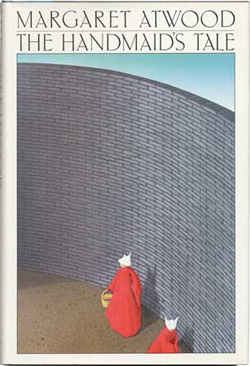
The Handmaid’s Tale is a disturbing, intriguing novel. It’s very much a novel of excellent prose and slight shifts rather than big explosions, and you need to be digging into every word as you read, but the experience is well worth it. My only qualm is the needlessly ambiguous ending, especially since any actual doubts are resolved in the epilogue.

The first Black Company novel in the omnibus was interesting due to the writing’s simplicity and the world’s refreshing amorality, but I wasn’t totally sold on the series. I can’t say that I’m a total convert yet, but Shadows Linger went a long way toward winning me over. My main gripe with the first volume, the highly episodic nature of the plotting, is absent here, and the character of Shed gives the story some variety. I have no idea how Cook’s going to bring this to a close in just two hundred or so pages, but I guess I’ll find out when I read White Rose next month. Look for a review then.

I’ve heard again and again that Malazan gets worse as it goes along, and I know two or three people who dropped the series at Reaper’s Gale, and yet it’s having the opposite effect on me. I didn’t fall in love until House of Chains, and each successive volume seems to just drag me deeper. This volume wasn’t perfect, of course (none of the Malazan books are even close to that), but like with all the other volumes, there are enough jaw dropping positives to overpower the occasional cringe worthy negative. I’m going to try and wrap up the Malazan series in a grand series of reviews once I get caught up.

Mad Ship is even better than Ship of Magic, and Ship of Magic in turn was even better than Farseer. At this rate, Liveships is going to quite possibly become my favorite trilogy. The characterization is just as good here, the world is broad and interesting, and the plot will occasionally surprise the hell out of you…though it probably wouldn’t have helped if the back cover didn’t reveal the first few hundred pages of the book quite so glibly. Look for my review once I finish the trilogy.

I’ve said it before (to myself, if that counts) that Stephen King is the best modern horror author there is (though I haven’t read nearly enough to properly make that statement), and that The Shining is his best novel (there I think I can qualify, having read over twenty of ‘em). I’ve been truly terrified by three stories – and I mean terrified, not kinda uncomfortable or whatever the hell most horror movies are shooting at – and the Shining has one of those three scenes. The horror, however, is far from the main part. Jack’s struggle with himself is torturous to watch, yet some of the best writing I’ve ever read. The ending is awful, but compared to some of King’s others it’s only kinda-awful, so I guess we’re lucky there. If you haven’t read the Shining yet, you’re missing out.

I have no idea why I picked Stephen King’s latest short story collection, when his earliest was stocked right next to it, no less, but I did, and I really wish I hadn’t. Everything’s Eventual is the first time that I’ve been truly disappointed by King, but damn did it hurt. My complete review is here.

The City and the City is a bit of an outlier for Mieville, but it succeeds at what it set out to do with ease. The book’s cornerstone, the two overlapping cities and their mutual ignoring campaign, is thought provoking and well handled, and the cinematic prose style (as in a lack of interior thoughts, not a lot of explosions) conveyed the atmosphere quite well. Unfortunately, both of those are interesting techniques that don’t make for easy reads. In addition, the ending, while technically filling all of the holes, was more than a bit disappointing. Though I don't necessarily agree with his conclusions, James has a good review of this up that should let you get a decent idea of the contents.

You know when you’ve built your expectations about something to the point where you know it’s going to disappoint you? And then it surpasses even those? Yeah, that’s what happened with Terminal World. It’s not a perfect novel, but it’s impossible to predict and written with a ridiculous amount of panache. If I were to compare it to something, I’d say that it’d be an odd mixture of Century Rain, Mieville’s bibliography. If you like Reynolds, you need to read this. If I succeed in composing my thoughts, I’ll write a review of this in a week or two. Until then, I'll contrast the Wert review I posted earlier with the Walker of Worlds one that I just read. Though some of the things he disliked were precisely why I loved the book, the review's quite informative and should give you a good idea of what you're getting into. UPDATE, I've now reviewed this here.
Old Man’s War was a fun, easy ride that had some intriguing ideas under its hood. The whole experience was slightly marred, however, by occasional clichés (which aren’t helped by Scalzi’s pointing them out) and a few scenes that are just too over the top to be effective. If you’ve read the book, you know what I mean. Hint: it involves Lilliputians. Still, I’ll be reading more of Scalzi’s work without a doubt. If you want a more comprehensive look at the novel, check out Aidan’s review. For a glimpse of some more of the novel's faults, go here.

This was absolutely delightful. The play is laugh out loud funny at several points, and the underlying ideas are brilliant. I only have two regrets: 1. That I couldn’t see it performed, and 2. That I didn’t get a chance to write down some of the passages before having to return my copy.

Not every story in this collection works, but every story tries something new and imaginative. There are three main story cycles here, as well as a few miscellaneous pieces, and all three are quite varied. The collection contains little in the way of new Ambergris material, though that’s not to say none, but the Incan stories are completely new and quite intriguing. Though I’d already read the majority of the Veniss stories in Veniss Underground, I was far more impressed the second time around, and I think my older treatment of them was more than a tad superficial. VanderMeer has yet to disappoint me, and he certainly didn’t do it here.
Tuesday, December 8, 2009
Jeff VanderMeer - Veniss Underground
.jpg)
Let me tell you about the city…
I don’t think that I’ve ever been this floored by a novel (A Storm of Swords at least had the dignity to come with a warning label in the form of the prior two volumes). VanderMeer is an author whose name seems to be pretty universally revered, when recognized, amongst SFF fans. For what feels like months, I’ve been looking for A City of Saints and Madmen. After having my search thwarted by every bookstore in Long Island, Rhode Island and Massachusetts, I finally found Veniss Underground in a college bookstore just before giving up hope. I had never heard of it, but by then I was willing to try anything with VanderMeer’s name, or a close approximation of it, on the spine.
The book was, as can be inferred by the first sentence, stunning. It’s set far in the future, in a time when earth’s various cities have become high tech city states. For a time, Veniss enjoyed a golden age, but, for causes unspecified, the city’s government came crashing down. In its absence, the various districts of the city have become independent in their own right, and the city’s underground is spilling into daylight. Though he is only visible for a brief time, Quin is the catalyst of the entire book. It is his influence that sets every one of the characters on their path.
The glory of the book doesn’t come from the plot. It’s in the prose and characters that the magic is truly found. Experimental techniques such as second person and its kind are viewed with – not undeserved – hesitation by most readers. It takes a book like this to remind us that it isn’t the techniques that are bad, just their continual misapplication. The writing here is filled with great phrases, yet remains clear throughout. Allusions to other literary works fill the story, Dante’s Inferno and countless other classics and myths prominent among them.
The book is structured in three parts of increasing length, one from each of the character’s perspectives. Different parts are each written in a totally different viewpoint style and vary considerably in atmosphere. The first of these is told by Nicholas. Despite being the reason that the rest of the characters are dragged down into the underworld, Nicholas’s screen time is quite brief. His chapters are written from a selfish first person perspective, and, as a failed artist and “slang jockey” are littered with turns of phrase that vary from insightful (The city is sharp, the city is a cliché performed with cardboard and painted sparkly colors to disguise the empty center – the hole), to amusing (replacing IE with Eye E, for instance), to downright pretentious (wait, listen: the end of the world is night; that’s mine, a single-cell haiku).
The second part of the book is told from Nicola’s perspective. Prose here is written in a second person, present tense style. This not only sucks you in beautifully, after a few seconds of adjustment, but also provides some of the best writing:
You. Were. Always. Two. As one: Nicola and Nicholas, merging into the collective memory together, so that in the beginning of a sentence spoken by your brother you knew the shadow of its end and mouthed the words before he said them.
The third part of the book is told from Shadrach, Nicola’s former lover. His style is told in a more detached third person perspective. Here, the eye grabbing writing is pushed farther back, to allow the outside world to shine through more clearly. For a few instants this transition seems like a shame, but the prodigal strangeness of the underworld makes up for it with ease. Shadrach’s section forms the largest portion of the book and from him we learn the most about Veniss, and about all of the characters. Prior misconceptions are set to rights, and there are two moments of brilliance that can best be described as the structural equivalent of a plot twist.
The underworld is strange in a way that few other fantasies have ever managed to be. It can, perhaps be compared to Mieville for sheer inventiveness, but the comparison comes more from the authors’ titanic imaginations than any true similarity. As the quest continues, and Shadrach descends from level to level, the strangeness becomes ever more profound. There are scenes of horror here, and scenes of wonder, and all of them are perfectly envisioned and conveyed.
Also contained in the volume are three short stories and a novella, all set within the Veniss milieu. The short stories are all interesting, but none approach the level of the preceding novel. The greatest of them is the third, A Heart For Lucretia. Its interesting structure, and bizarre chain of events, is captivating, yet the entire thing felt like it was perpetually on the edge of greatness, unable to cross over within its limited length.
The novella, Balzac’s War, is the best of the extra content. Like the shorts, it takes place far after the main story, and is centered on a war between humanity and the flesh dogs. The story begins with a brief scene, then jumps a large number of years. The reasons for that never become wholly apparent, but the story has strong characters and is highly unsettling nonetheless.
Veniss Underground is a story that draws you in and does not let you go, filled with memorable characters and troubling themes, evocative images and unforgettable action. It is not something that should be allowed to pass by. If you don’t have it, you have done a grievous disservice to yourself. Remedy that at once.
All of this leaves A City of Saints and Madmen with quite a bit of living up to do.